

Celebrity Weight Loss Drugs Explained: What Headlines Can, and Can’t, Tell You

Updated: 5 days ago
A transformation photo is not a medical record. Headlines about celebrity weight changes may mention a treatment category, but they rarely confirm what a person used, why it was chosen, or what their health journey involved. That’s the distinction at the heart of having celebrity weight loss drugs explained without turning speculation into fact.
If you’ve found it hard to separate verified information from rumor, you’re not alone. A change in someone’s appearance may prompt questions, but it cannot reveal that person’s medical history or show whether a particular approach would suit you. Your health decisions deserve more than comparisons or assumptions.
This article explains what the broad category in many celebrity headlines may refer to, what public stories can and can’t tell you, and how to prepare questions for an appropriate healthcare professional. It also covers how structured support, including weight-loss counseling and provider-guided wellness programs, may help you explore options with care and realistic expectations.
Table of Contents
Celebrity weight loss drugs explained: what headlines mean
When headlines discuss a celebrity’s weight change, are they reporting a confirmed treatment or repeating a popular theory? The phrase celebrity weight loss drugs explained usually points to a broader conversation about medical approaches to weight management. By itself, it does not confirm what any individual has used or experienced.
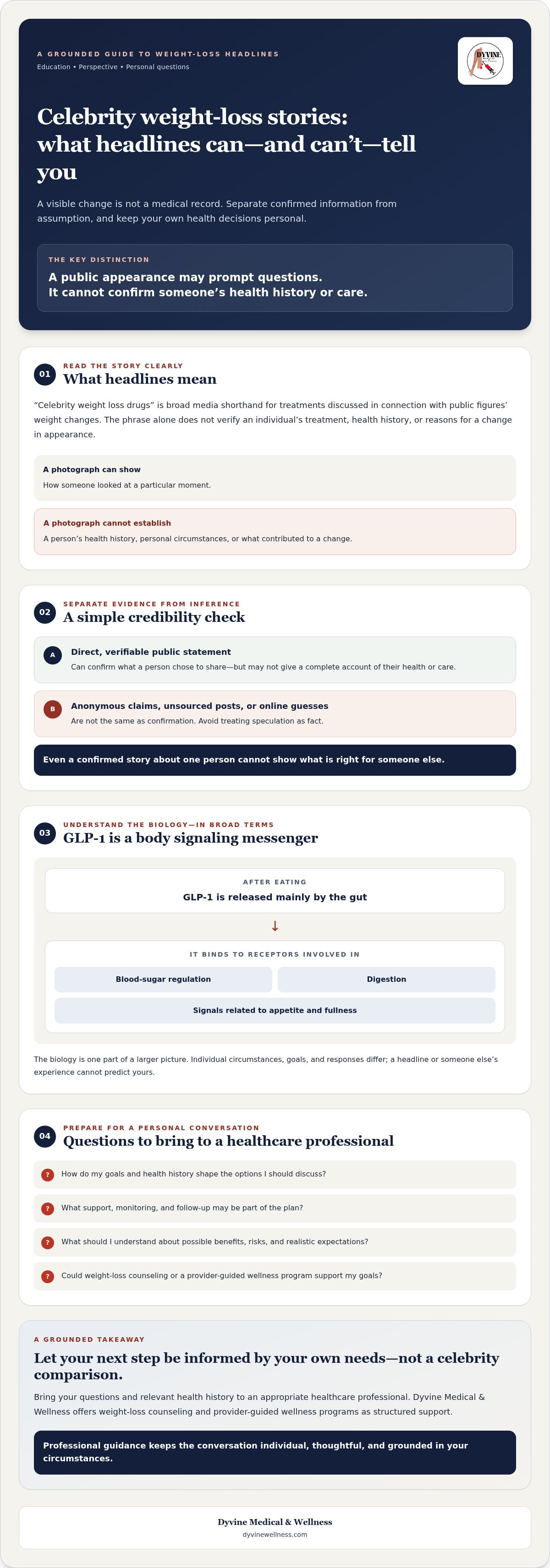
Featured snippet definition: “Celebrity weight loss drugs” is broad media shorthand for treatments discussed in connection with public figures’ weight changes. The phrase alone doesn’t verify an individual’s treatment, health history, or reasons for a change in appearance.
Public attention can make a personal health topic feel like a puzzle for everyone to solve. A useful explanation separates documented information from speculation and respects what people choose to keep private.
Why celebrity weight-loss headlines attract attention
Familiar faces, striking before-and-after narratives, and fast-moving social media can turn an appearance change into a widely shared story. But a photograph shows only how someone looked at a particular moment. It cannot establish their health history, personal circumstances, or whether a specific approach contributed to the change.
What the phrase does, and does not, identify
The label may refer broadly to GLP-1-related treatments, including GLP-1 receptor agonists, but it does not identify a specific product, care plan, or clinical decision. Those details require reliable confirmation, not inference from someone’s appearance.
A person’s direct, verifiable public statement can confirm what they chose to share. It may not provide a complete account of their health or care. Anonymous-source claims, unsourced posts, and online guesses are not the same as confirmation. Even a confirmed statement about one person cannot show what may be appropriate for someone else.
When reading or discussing these stories, separate documented information from speculation, respect personal privacy, and avoid treating a visible transformation as proof of cause. These steps help keep headlines in perspective without making assumptions about someone’s health.
How GLP-1-based weight-management treatments work in broad terms
Understanding the biology can make headlines easier to interpret, but it cannot predict an individual’s experience. GLP-1 is short for glucagon-like peptide-1, a hormone released mainly by the gut after eating. It binds to receptors involved in blood-sugar regulation, digestion, and signals related to appetite and fullness.
What GLP-1 refers to
Think of GLP-1 as one of the body’s signaling messengers, not a simple switch for weight change. GLP-1-based approaches are designed to act on this signaling system. In broad terms, this may influence appetite and slow the movement of food through the stomach, which can affect how full a person feels. The effects and their significance vary, so they are not a promise of a particular outcome.
The biology is only one part of the picture. A Washington University School of Medicine report discusses potential benefits and risks, underscoring why decisions about treatment call for individualized professional guidance rather than conclusions drawn from media stories.
Why individual experiences are not interchangeable
Two people considering the same broad treatment category may have different health circumstances, goals, and responses. A public figure’s account, even if shared directly, cannot tell you how your body might respond or whether a particular approach fits your needs. It also cannot establish another person’s complete health history or care plan.
That’s why celebrity weight loss drugs explained should lead to general education, not self-diagnosis or predictions based on someone else’s appearance. Do not treat an online anecdote as a guide to your own eligibility, expected results, timeline, or risks. Bring those questions to an appropriate healthcare professional who can consider your circumstances.
If you’re exploring weight-management support in Atlanta, prepare your questions and relevant health history for that conversation. Dyvine Medical & Wellness offers weight-loss counseling and provider-guided wellness programs. To understand whether this support fits what you are looking for, learn about weight-loss counseling.
What celebrity stories can, and cannot, tell you about weight loss
A public story can offer a glimpse into what someone has chosen to share. It cannot provide a complete account of their health or explain every change in appearance. Headlines can make a personal journey seem simple, even when the circumstances behind it are private and individual.
What a public account can confirm
If a public figure speaks directly and on the record about their experience, you can accurately report what they said about themselves. That is different from independently confirming their care or knowing their full medical history. News reports may relay details attributed to sources, but attribution alone does not make a claim medically verified. Careful coverage sticks to what is documented rather than drawing additional conclusions.
What appearance and headlines cannot prove
A photograph can show how someone looked at a particular moment. It cannot establish what treatment they received, their health status, or the reason their appearance changed. Lighting, styling, camera angle, and timing can also affect how images look. A visible transformation is not evidence that one specific approach caused it.
Weight and appearance can be shaped by many personal and contextual factors. Without reliable, relevant information, there is no way to know which factors applied to another person. One person’s account should not be treated as a typical experience or a promise of what someone else will experience.
Use this distinction to read coverage more carefully:
Fact: A person made a specific, attributable statement about their own experience.
Assumption: A photo proves which treatment they used or what caused a change.
Fact: A report describes a claim and identifies where it came from.
Assumption: An anonymous claim or social media guess confirms someone’s private health information.
When searching for celebrity weight loss drugs explained, look for clear attribution and careful wording. Ask whether a story reports a direct statement, repeats an unverified claim, or draws conclusions from appearance alone. This keeps public information in its proper place and leaves room for privacy. It also helps prevent a celebrity’s story from becoming a shortcut for understanding your health or choosing support.
Questions to ask before considering weight-management support
A celebrity story can prompt questions, but it cannot determine what is appropriate for you. Before exploring weight-management support, prepare to speak with an appropriate healthcare professional. You do not need to arrive with a decision already made. Start by identifying your goals, circumstances, and questions.
Prepare for a professional conversation
Write down what you hope to understand, along with relevant health history and current care. These questions can help keep the conversation focused:
1. Goals: How can we define goals that reflect my health needs and daily life?
2. Health history: What information about my health history, current care, or other factors should we consider?
3. Options and support: What approaches might be appropriate to discuss, and what support could be part of the process?
4. Monitoring: Who would oversee clinical decisions, and what follow-up or monitoring might be involved?
5. Next steps: How will we review progress and decide whether the plan needs to be revisited?
Recognize trustworthy wellness support
Wellness support should make its role clear. Ask who provides clinical decisions and medical care, what the wellness service includes, how your information is handled, and how coordination with other professionals works. Clear answers help you understand where education and counseling fit and where clinical care belongs.
Dyvine Medical & Wellness offers weight-loss counseling and provider-guided wellness programs. These services provide wellness support, but they do not replace clinical assessment or mean Dyvine independently makes medical decisions. If you are considering structured support, review Dyvine’s weight-loss counseling and ask about the service’s scope.
As you explore celebrity weight loss drugs explained, keep the focus on education rather than imitation. A public figure’s experience cannot determine your goals, suitability, or care plan. Bring questions to an appropriate healthcare professional and choose support that is transparent about its scope, coordination, and follow-up.
A grounded next step beyond celebrity weight-loss headlines
Celebrity stories can introduce a topic, but they cannot tell you which choices fit your health, goals, or circumstances. A thoughtful next step starts with your own needs, not someone else’s appearance. Clarify what you hope to understand and bring your questions to an appropriate healthcare professional.
What Dyvine Medical & Wellness can offer
Dyvine Medical & Wellness offers weight-loss counseling and provider-guided wellness programs. These services offer wellness support and coordination, but Dyvine does not diagnose, treat, or prescribe, and no particular outcome is guaranteed. Understanding each provider’s role can help you see how wellness support may fit alongside care from an appropriate healthcare professional.
All medical services are provided in accordance with applicable regulations. Dyvine Medical & Wellness provides specimen collection, education, and coordination services.
Taking a considered next step
Before contacting a provider, write down your questions, goals, and relevant health history. Ask what support is offered, who makes clinical decisions, and how coordination or follow-up works. Clear information can help you decide whether a service aligns with your needs, without pressure to make a choice based on a headline.
For anyone searching celebrity weight loss drugs explained, the key takeaway is that public stories offer context, not a personal care plan. Your next step can be steady and informed.
Learn about wellness support from Dyvine
Choose a wellness path grounded in your needs
Understanding “celebrity weight loss drugs explained” means looking beyond headlines. A public figure’s statement may offer limited insight, while photos and speculation cannot establish another person’s health history, care decisions, or likely results for you.
GLP-1-based treatments relate to biological signals involved in appetite and digestion, but individual circumstances and responses differ. Before exploring weight-management support, consider your goals and health history. Prepare questions for an appropriate healthcare professional about clinical decision-making, ongoing support, and follow-up.
Dyvine Medical & Wellness offers weight-loss counseling, provider-guided wellness programs, and comprehensive wellness panels. These services can support your wellness journey, while clinical decisions remain with an appropriate healthcare professional. You do not need to measure your path against someone else’s. A thoughtful next step can begin with a clear question and support that respects your individual needs.
Frequently Asked Questions
What are celebrity weight loss drugs?
“Celebrity weight loss drugs” is media shorthand for treatments discussed alongside public figures’ weight changes. The phrase does not identify a specific treatment or confirm that a particular person used one. When searching for celebrity weight loss drugs explained, distinguish direct, attributable statements from anonymous claims, online speculation, and assumptions based on appearance. Headlines can introduce a topic, but they cannot reveal a person’s complete health history or care plan.
Are GLP-1 treatments the same as weight-loss drugs discussed in celebrity headlines?
Not necessarily. Some headlines use broad language that may refer to GLP-1-based treatments, but the phrase “celebrity weight loss drugs” does not reliably identify a treatment category, product, or care plan. Check whether reporting provides a clear, attributable source. Even when someone shares an experience publicly, that account may not explain every aspect of their care or independently confirm details.
Can you tell what treatment a celebrity used by looking at before-and-after photos?
No. Photos show someone’s appearance at particular moments, not their treatment, health status, or reasons for a change. Differences in timing, styling, lighting, and camera angle can also affect how images appear. Unless someone has shared information directly and reliably, do not infer private health details from photographs. A visible change alone cannot establish what caused it.
Do celebrity weight-loss stories show what will work for everyone?
No. Another person’s story cannot predict what may be suitable or effective for you. Health history, personal goals, and other individual circumstances matter, while public accounts rarely provide enough detail to explain the full picture. Treat celebrity stories as personal accounts, not instructions or promises. Discuss your questions with an appropriate healthcare professional who can consider your circumstances.
What should I ask a healthcare professional about weight-management support?
Start with questions about your goals and the options that may be appropriate to discuss. Ask what health-history information is relevant, who makes clinical decisions, what ongoing support or monitoring may involve, and how follow-up will work. Share your current care and ask for clarification if anything is unclear. A conversation can help you understand possible next steps without requiring you to decide in advance.
What is the role of a wellness program in weight-management care?
A wellness program can offer education, counseling, or structured support, depending on its scope. Do not assume that it provides clinical assessment or makes medical decisions. Ask who is responsible for clinical care, how coordination works, and which professional to contact with health questions. Dyvine Medical & Wellness offers weight-loss counseling and provider-guided wellness programs as wellness support.
Where can I find weight-loss counseling in Georgia?
Dyvine Medical & Wellness offers weight-loss counseling and provider-guided wellness programs, with a local focus that includes Stockbridge, Atlanta, McDonough, Jonesboro, Decatur, Covington, Conyers, Jackson, Macon, Columbus, Lawrenceville, Snellville, Buford, Sugar Hill, Griffin, Senoia, Peachtree City, and Fayetteville. Contact Dyvine to learn about available wellness support and ask questions about its scope before deciding whether it fits your needs.


Comments