

Proving Paternity for Inheritance Rights in Georgia: DNA Tests and Legal Steps

Could a DNA result establish a biological connection without settling inheritance rights on its own? For families focused on proving paternity for inheritance rights Georgia law recognizes several possible paths, and the distinction between genetic evidence and legal parentage matters. A test can provide important evidence, but its legal relevance depends on how it is collected, presented, and considered in the applicable process.
It’s understandable to want a clear answer when a loved one’s estate or a child’s family history is involved. This guide explains how DNA evidence may fit under Georgia law, how personal-use testing differs from legal DNA testing, and what to discuss with a Georgia attorney. It also explains why establishing paternity and pursuing legitimation are separate legal processes, and why one should not be assumed to replace the other.
Dyvine Medical & Wellness provides legal and non-legal DNA paternity testing with professional specimen collection in-office or through mobile services. Legal testing can support a formal process, but it doesn’t replace legal advice or determine an inheritance outcome. Understanding the evidence and possible legal steps can help families move forward with greater clarity.
Table of Contents
Can proving paternity establish inheritance rights in Georgia?
How do paternity, legitimation, and inheritance differ under Georgia guidance?
Legal and non-legal DNA tests: which option fits an inheritance question?
What steps can Georgia families take when paternity may affect an estate?
How Dyvine Medical & Wellness supports paternity testing in Georgia
Can proving paternity establish inheritance rights in Georgia?
If a child may have a claim to an estate, it’s natural to ask whether DNA evidence can help establish the family connection. In Georgia, the answer involves more than biology. A genetic test may provide evidence of a biological relationship. Legal parentage concerns how that relationship is recognized under applicable law, while legitimation is a distinct legal process. These concepts can intersect, but they do not mean the same thing.
Georgia Courts explains that a child born outside marriage does not automatically inherit from the father solely because of a biological relationship. State law addresses inheritance through specific legal circumstances, which may include a court order establishing paternity, a legitimation order, or other evidence recognized under the law. The relevant route depends on the facts and the estate circumstances. That is why proving paternity for inheritance rights Georgia families may need to consider involves looking beyond the test result itself.
What does a paternity test establish?
A paternity test analyzes genetic material to assess whether there is a biological relationship between a child and an alleged father. It can provide evidence, but it does not decide who inherits, issue a court order, or independently resolve an estate claim. For a plain-language introduction to the testing process, explore Dyvine’s DNA paternity testing services. Before arranging testing, consider how the result is intended to be used, particularly if a formal legal process may be involved.
Why can inheritance depend on more than biological paternity?
Georgia Courts’ guidance on legitimation highlights that establishing a biological connection and completing a legal process are separate matters. This reflects a broader principle in paternity law: family relationships can raise distinct questions about evidence, legal status, and rights, each governed by applicable rules. The route relevant to an estate may depend on family history and on records or court actions already in place. A qualified Georgia attorney can help assess which rules apply to a specific situation.
A DNA result and a legal status are not the same thing. A test may contribute evidence, while the legal effect of that evidence depends on the applicable process and circumstances. Families may need to clarify whether they are seeking to establish a biological relationship, understand an existing legal determination, or address a claim involving an estate. These questions can overlap, but answering one does not necessarily resolve the others.
Before relying on a result or taking action, clarify the estate question and seek Georgia legal guidance. This can help you understand which records and testing, if any, may be relevant. Dyvine Medical & Wellness provides legal and non-legal DNA paternity testing with in-office and mobile specimen collection. The service supports testing needs; it does not determine inheritance rights or replace legal representation.
How do paternity, legitimation, and inheritance differ under Georgia guidance?
These terms often appear together in estate questions, but they describe different things. Biological evidence concerns a genetic relationship. Legitimation is a legal process described by Georgia Courts. Inheritance questions concern whether a child may claim from an estate under the circumstances and applicable law. Keeping these distinctions clear helps families identify what they need to understand without assuming that one record or test resolves every issue.
Biological evidence may show a genetic connection, while a legal determination depends on the applicable legal process. That distinction is central to proving paternity for inheritance rights Georgia families may be considering.
What is legitimation, and how is it different from paternity testing?
Georgia Courts explains legitimation as a legal action concerning an unmarried father’s relationship with a child. A paternity test addresses biological evidence; it does not complete that court process. The court’s information identifies Superior Court as the venue for a legitimation petition. Requirements and outcomes depend on the particular case, so this overview is not filing instructions or a prediction of what a court will decide.
The official Georgia Legitimation Process resource explains the state court’s process. Reviewing it can help you understand the terminology. A Georgia attorney can advise how it may apply to a family’s circumstances.
Does a will or birth certificate settle inheritance rights?
Not necessarily. Georgia Courts’ examples distinguish a document that records or describes a relationship from a court determination of legal status. A birth certificate may contain parent information, and a will may name a child, but neither should automatically be treated as proof that every inheritance question is resolved. A history of support or a DNA result should not be treated as automatic legitimation either.
The details matter. A will, estate records, family history, and prior legal determinations may all shape the question. This section is not a complete statement of estate law, so have the specific documents and circumstances reviewed by qualified Georgia legal counsel. If testing is being considered as part of that discussion, Dyvine Medical & Wellness offers legal DNA paternity testing with professional specimen collection. Testing does not determine inheritance rights or replace legal representation.
Legal and non-legal DNA tests: which option fits an inheritance question?
Choosing a DNA test starts with a practical question: what do you need the result to help you understand? A test intended for personal knowledge and one being considered for a formal matter may serve different purposes. Neither option, by itself, guarantees inheritance rights or replaces the legal process for addressing an estate. Before arranging testing, identify the question you are trying to answer and whether an attorney has recommended a particular approach.
For families considering proving paternity for inheritance rights Georgia, the intended use of the result matters. The word “legal” describes a testing option intended for potential formal use. It does not promise that a court or estate decision-maker will accept or rely on the result in every situation. Requirements can vary with the matter. A Georgia attorney can help clarify what information is relevant to a specific estate question.
When might legal DNA testing be relevant?
Legal DNA testing may be relevant when documented specimen collection procedures matter to a formal process. Dyvine Medical & Wellness offers legal DNA paternity testing with professional specimen collection in-office or through mobile services. Before testing, discuss the matter with your attorney so the testing option aligns with the legal question and any requirements relevant to your case. The test provides evidence, not a legal determination.
When is non-legal testing intended to be used?
Non-legal testing may help answer a personal question about a biological relationship. It should not automatically be treated as proof that changes inheritance rights or satisfies a court or estate process. If you are weighing options, separate personal understanding from formal legal use, and seek legal guidance before relying on a result in an inheritance matter.
Compare the options by considering their purpose, not simply the test result:
Personal understanding: Non-legal testing is intended to address a private question about biological relatedness.
Potential formal use: Legal testing is intended for situations where professional collection procedures may be important. It does not guarantee acceptance or a particular outcome.
Estate decisions: Either result may need to be considered alongside the applicable legal and estate process.
For a focused comparison of the available testing options, explore legal DNA paternity testing. Dyvine provides legal and non-legal testing, with in-office and mobile specimen collection. This is a testing service, not legal representation or a substitute for advice about a specific estate.
Clarify the purpose before scheduling. A conversation with qualified Georgia legal counsel can help you understand whether testing is relevant, which option aligns with the matter, and what other steps may need consideration. Preparing this way can make the next decision clearer while leaving legal conclusions to the appropriate process.
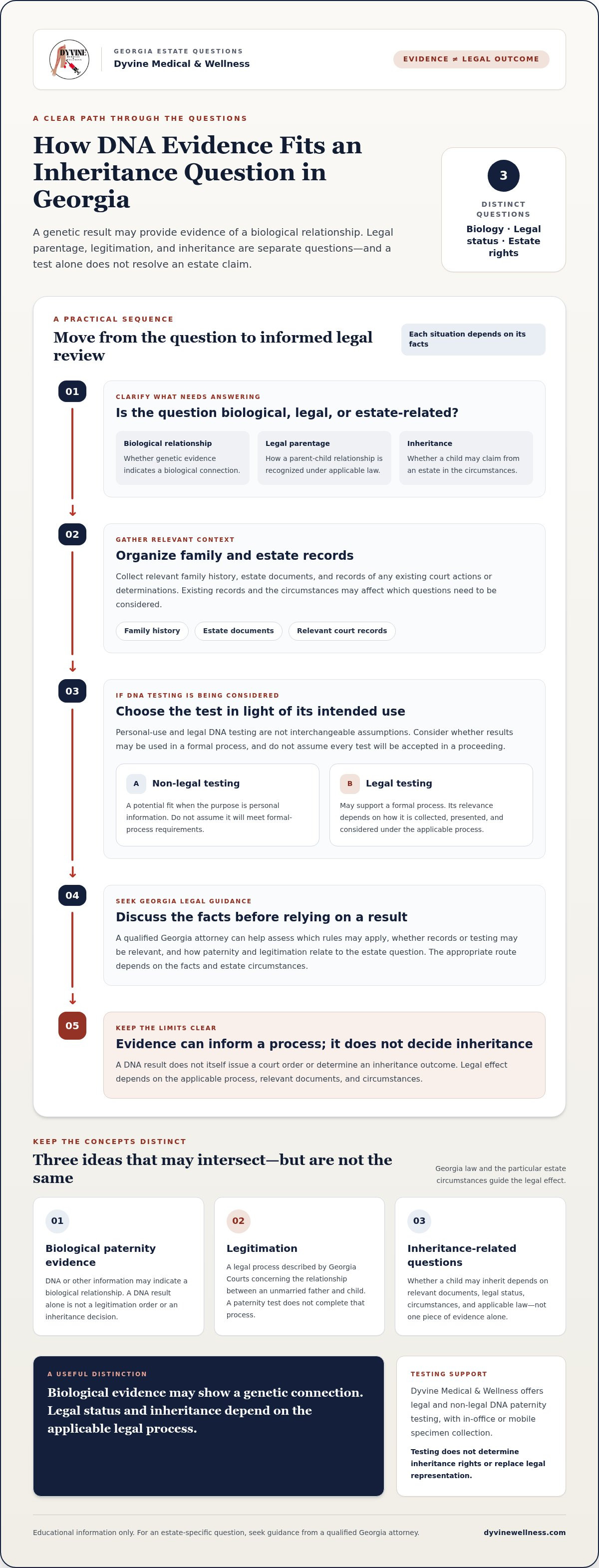
What steps can Georgia families take when paternity may affect an estate?
An estate question can feel personal and time-sensitive, especially when a family is trying to understand a child’s connection to a deceased or potentially deceased parent. Start by clarifying what needs an answer before arranging testing or taking procedural action. The goal is to organize the facts and seek guidance, not to assume that one document or test will settle the matter.
The proper next step depends on the facts and the legal issue involved. This orientation checklist can help you prepare for a conversation with qualified Georgia legal counsel. It is not legal advice or a set of instructions for opening an estate claim.
What information should a reader organize before seeking guidance?
Gather the records available to you. Not every item will apply to every family, but an organized summary can help counsel understand the situation and identify what may be relevant to proving paternity for inheritance rights Georgia families are considering.
Family and birth records: Birth certificates, records identifying parents, and documents that may describe family relationships.
Existing legal records: Any court orders or other legal documents concerning parentage or the family relationship.
Estate documents: A will, estate correspondence, or other records related to the estate, if available.
A simple timeline: Note relevant dates and events, such as when family members lived together, when documents were created, or when an estate matter arose. Distinguish confirmed details from recollections.
Keep original documents secure and organize copies for review. Family, birth, and estate records can contain sensitive information, so share them through appropriate channels with the people assisting with the matter. Avoid altering documents, and do not treat a family account as a substitute for a record when the distinction matters.
Which questions should be resolved before arranging testing?
Before specimen collection, clarify the purpose of testing with your attorney, particularly if a court or estate matter is involved. These questions can help focus the discussion:
What specific legal or estate question is the test meant to inform?
Who may rely on the result, and how is it expected to be used?
Has counsel or a court specified a testing approach for this matter?
Are there existing records or legal determinations that should be reviewed first?
Discussing intended use before collection can help prevent a mismatch between a test selected for personal understanding and one considered for a formal matter. It also gives counsel an opportunity to explain how testing may fit alongside other records or legal steps. Do not assume a DNA result alone resolves probate, parentage, or inheritance questions.
For families whose legal guidance points toward testing, Dyvine Medical & Wellness offers legal and non-legal DNA paternity testing with in-office and mobile specimen collection. Explore legal DNA paternity testing as a professional collection option. Testing is one part of the broader process; it does not determine inheritance rights or replace legal advice.
How Dyvine Medical & Wellness supports paternity testing in Georgia
Families considering DNA testing need a professional service that recognizes both the personal significance of the question and the limits of what testing can establish. Dyvine Medical & Wellness offers legal and non-legal DNA paternity testing, with in-office and mobile specimen collection for clients in Georgia. The service supports testing needs; it does not decide a family’s legal status or an estate claim.
What can clients expect from a professional testing service?
Clients receive professional, client-focused support for paternity testing. Dyvine offers legal and non-legal options, distinguishing testing intended for potential formal use from testing for personal understanding. The right option depends on the intended use and any guidance related to the matter. Learn more about DNA paternity testing services and the available collection settings.
For someone weighing proving paternity for inheritance rights Georgia, discussing the legal question with qualified Georgia counsel before arranging testing can help clarify whether a particular test is relevant and whether a court or estate process involves additional steps. That context helps families approach testing with a clear purpose instead of expecting a result to resolve every issue.
In-office collection offers a clinic-based option, while mobile collection provides another way to access specimen collection. These are service settings, not separate legal pathways. The key distinction is the intended use of the test and how the result may relate to the broader question. Dyvine does not make legal determinations about parentage, inheritance, or estate rights.
Where does testing support end and legal advice begin?
DNA test results are not legal advice. They do not guarantee a specific court decision, establish an inheritance outcome, or replace the legal steps that may apply to an estate or parentage matter. Dyvine provides testing and specimen collection services, not legal representation or a determination of which legal process applies to an individual family.
If a court or estate matter is involved, coordinate questions about the test’s intended use with qualified Georgia counsel. That guidance can help you understand how testing may fit with relevant records and legal procedures. Each family’s circumstances are different, and no test result should be treated as a promise of a particular outcome.
Families can take this process one step at a time: clarify the question, seek legal guidance where needed, and choose a testing option that aligns with the intended use. Dyvine Medical & Wellness provides professional DNA paternity testing and specimen collection in Stockbridge, Atlanta, McDonough, Jonesboro, Decatur, Covington, Conyers, Jackson, Macon, Columbus, Lawrenceville, Snellville, Buford, Sugar Hill, Griffin, Senoia, Peachtree City, and Fayetteville. Schedule an appointment to discuss testing services.
Move Forward with Clarity
Questions about family lineage and an estate can carry emotional weight, so give yourself room to proceed thoughtfully. Before making a decision, write down the specific question you need answered and the guidance you still need. That pause can keep the next step focused, especially when proving paternity for inheritance rights Georgia is part of a larger family or estate matter.
Use qualified Georgia legal counsel for advice about your circumstances, and treat testing as a service step rather than a promise of a legal result. When you are ready to arrange DNA testing, consider its intended use and keep your questions close at hand. If the circumstances are complex, a written list of open questions can make conversations more focused and clarify what remains unresolved. You do not need to have every answer before taking a thoughtful next step.
Schedule an appointment for professional DNA testing with Dyvine Medical & Wellness. Move forward at a manageable pace, with clear questions and appropriate support.
Frequently Asked Questions
Does a DNA test automatically give a child inheritance rights in Georgia?
No. A DNA result does not by itself guarantee inheritance. Georgia law describes several ways a child born outside marriage may qualify to inherit from a father or paternal relatives. Which route may apply depends on the evidence and estate circumstances, so have the specific situation reviewed by a Georgia attorney.
Is legitimation the same as establishing paternity in Georgia?
No. Establishing paternity concerns the father-child relationship; legitimation is a separate court process. They can have different legal effects, and one should not be assumed to replace the other. A Georgia attorney can explain which issue is relevant to a particular family or estate matter.
Can a child inherit from an unmarried father in Georgia?
Yes, under circumstances recognized by Georgia law. These may include a court order, qualifying genetic evidence filed with the court, or other specified evidence of the relationship. The applicable route depends on the facts, so a child or family member should get legal guidance before relying on a particular record or test.
What is the difference between a legal and non-legal paternity test?
Legal testing is intended for situations where professional collection procedures may matter to formal use. Non-legal testing is generally intended for personal understanding. Neither label guarantees that a result will be accepted in a specific proceeding. If a court or estate matter is involved, discuss the testing purpose with counsel before collection.
Can a birth certificate prove paternity for inheritance in Georgia?
A father’s signature on a birth certificate is one circumstance Georgia law identifies in connection with inheritance for a child born outside marriage. The document’s relevance depends on the facts and the estate, however. Have the actual certificate and any related records reviewed rather than assuming the document resolves every legal question.
Where can I get legal DNA paternity testing near Atlanta, Georgia?
Dyvine Medical & Wellness offers legal DNA paternity testing in its Georgia service area, including Atlanta and Stockbridge. In-office and mobile specimen collection are available. If testing relates to an estate or court matter, consult qualified Georgia counsel about intended use. Testing services do not provide legal representation or determine inheritance rights.


Comments