

How to Read a Drug Test Report: A Clear, Step-by-Step Guide

What does a drug test report actually tell you? If terms like “cutoff,” “screening,” or “invalid” feel unfamiliar, it can be difficult to know what the result establishes and what still needs clarification. Knowing how to read a drug test report starts with reviewing each field in context, rather than treating one label as a complete conclusion.
This guide explains common report sections and result categories, including the difference between a preliminary screen and a confirmed result. It also covers why methods and reporting practices vary, what details to note, and where to direct questions about a specific testing process. A report can provide useful information, but its meaning depends on the test and the process behind it.
Dyvine Medical & Wellness provides DOT, non-DOT, and rapid drug testing in Georgia, with professional specimen collection support. All medical services are provided in accordance with applicable regulations. Dyvine Medical & Wellness provides specimen collection, education, and coordination services.
Table of Contents
How to Read a Drug Test Report: Start With the Test Details
A report can feel dense when technical terms appear before their context. Start with the details that identify the test, rather than jumping straight to the result label. A drug test report records a specific test, the specimen examined, and the findings reported under that test’s process.
This first step in how to read a drug test report can help you avoid comparing unlike tests or expecting one label to answer questions beyond its scope. Reports may differ by specimen, test panel, and reporting organization. For general background on common testing types and uses, see the Drug test overview. Your own report remains the reference for what was performed.
Find the test type, specimen, and panel
Look for fields labeled “test type,” “specimen,” “panel,” or similar wording. A report may identify urine, hair, or oral fluid, among other specimen types. Testing approaches can vary by specimen, so don’t assume that details associated with one type apply to another.
Next, locate the panel or list of substances tested. The findings relate to the substances included in that specific panel, not necessarily every substance that could be tested for. Read the panel alongside the test’s stated purpose and the reporting organization. If the report uses an abbreviation or code, note it and ask the program contact what it means instead of guessing.
For workplace testing, the program or testing category can help establish context. For a general description of DOT and non-DOT drug testing, review the service information, while relying on your report and program for the specific details of your test.
Check report dates and identifying details
Collection and reporting dates may appear in separate fields. The collection date indicates when the specimen was obtained. A reporting date, if shown, indicates when the result was recorded or issued. The report may also identify the organization that handled or reported the test.
Check that the name or identifier matches the document you intend to discuss. Dates and identifiers help distinguish one report from another, especially when you’re keeping records for work or personal use. If you share a report to ask a question, protect your privacy by covering personal identifiers that aren’t needed. A concise note with the field name, date, and exact wording can help you raise a focused question without sharing more information than necessary.
What Negative, Positive, and Invalid Drug Test Results Mean
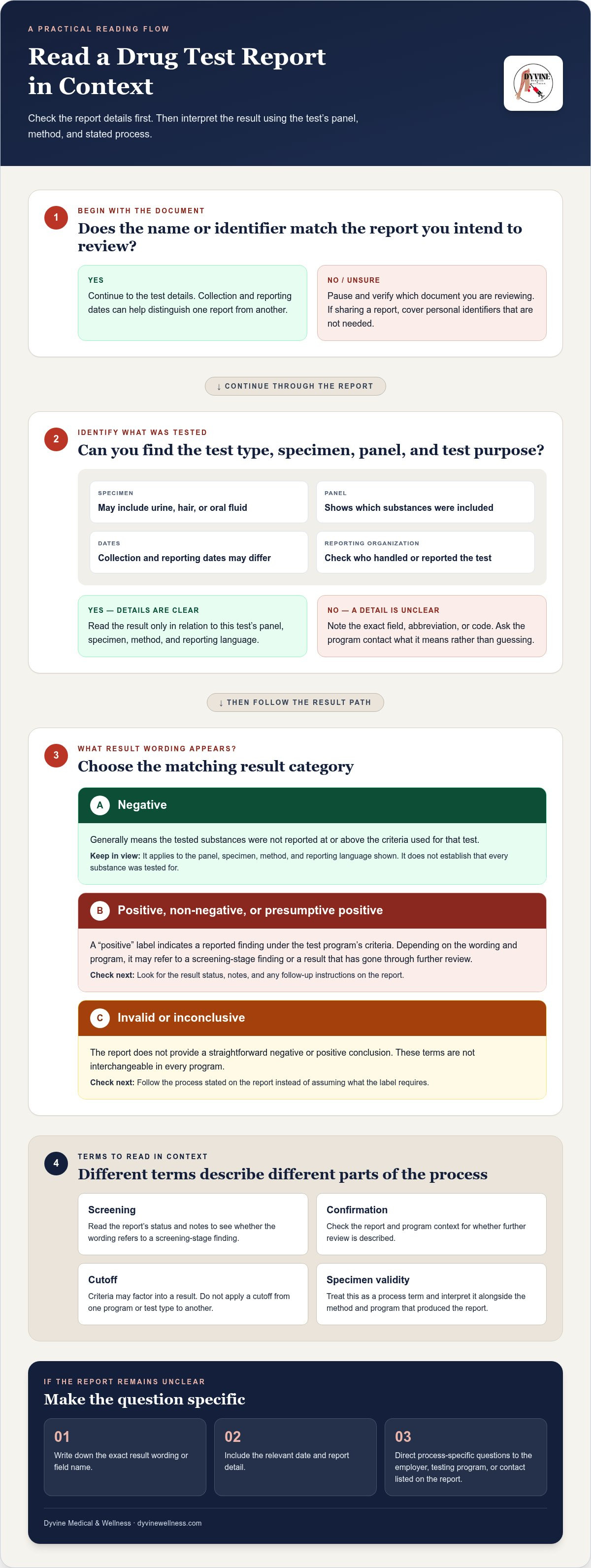
Result labels can look definitive, but their meaning depends on the test’s panel, method, and reporting rules. A reported result describes what a specific test found under its stated conditions, not a complete account of a person’s history or circumstances. Keep that distinction in mind when reading the report and deciding what needs clarification.
Terminology varies. One report may use “non-negative” or “presumptive positive” for a result that needs additional review, while another may use different wording. Read notes, status descriptions, and follow-up instructions alongside the main result. If the report identifies a particular program, follow that program’s stated process.
How to understand a negative result
“Negative” generally means the tested substances weren’t reported at or above the criteria used for that test. It doesn’t establish that every substance was tested for or that a substance was never used. The result applies to the panel, specimen, method, and reporting language shown on the report.
For example, if a panel covers only specified substances, a negative result doesn’t speak to substances outside that panel. In DOT urine testing, applicable cutoff criteria are set out in federal regulations. The Cutoff concentrations for urine drug tests are one reference for understanding how thresholds may factor into a result. Don’t apply a cutoff from one program or test type to another.
How to understand a positive or inconclusive result
A “positive” label indicates a reported finding under the test program’s criteria. Depending on the program and the wording, it may describe a screening-stage finding or a result that has gone through further review. Check the report for its status and any explanation of what happens next. The label alone doesn’t explain every circumstance related to the finding.
“Invalid” or “inconclusive” means the report doesn’t provide a straightforward negative or positive conclusion. These labels aren’t interchangeable in every program. The report may specify a next step or identify a contact for questions. Follow the stated process rather than assuming the label means the test was negative, positive, or requires a particular action.
To make a clear inquiry, note the exact result wording and where it appears on the report. Direct process-specific questions to the employer, testing program, or contact listed on the document. Dyvine Medical & Wellness provides DOT and non-DOT drug testing in Georgia, with professional specimen collection and coordination support. All medical services are provided in accordance with applicable regulations. Dyvine Medical & Wellness provides specimen collection, education, and coordination services.
Screening, Confirmation, Cutoffs, and Other Report Terms
These terms describe different parts of a testing process. Read each one alongside the field where it appears. Report terminology needs to be understood in the context of the method and program that produced it. The table below can help you identify what a field generally refers to before looking for its specific explanation in the report.
Programs may use different stages, procedures, and labels. For general information about drug testing and result interpretation, MedlinePlus’s overview of drug test results provides background. The report’s own instructions describe the process relevant to your test.
Screening and confirmation are not interchangeable terms
When a program uses screening, it serves as an initial stage. A finding may be identified as preliminary, and the report may indicate whether further analysis applies. Confirmation refers to additional analysis used by some programs to assess a screening finding. Because the terms describe different steps, check the report’s status wording instead of treating them as equivalent.
Cutoffs, validity checks, and review fields
A cutoff is specific to the test program and shouldn’t be treated as a universal figure. A specimen-validity field may identify a status that affects how the program handles the sample. Some reports also include a Medical Review Officer field. Its relevance depends on the program, so refer to the report’s instructions for the applicable review process.
If your question concerns the type of testing arranged, the overview of DOT and non-DOT drug testing can help you recognize the program context. For a specific report, use its stated method, field labels, and instructions as your reference. These details provide a clearer foundation for asking the testing program a precise question.
What to Do When a Drug Test Report Is Unexpected or Unclear
An unfamiliar field can raise questions, especially if the wording differs from what you expected. Pause before drawing conclusions. Review the complete document, including notes and instructions, and mark the specific label or entry that concerns you. A question tied to a particular field is easier to direct to the right contact than a broad request to explain the whole report.
For process-specific clarification, contact the employer, testing program, or representative listed on the report. Procedures and timelines can differ, so don’t assume a particular review, retest, or outcome will follow. An informational guide can explain common terms, but it can’t determine the meaning of an individual result.
Questions to ask about the report process
Prepare a few focused questions before reaching out. Ask which method and panel the report covers, what the specific status label means in that program, and whether additional review applies. If the document refers to an unfamiliar process, ask where its instructions are explained. These questions seek procedural clarification without presuming what the finding means.
Keep a copy of the report and note its date. If you speak with a representative, record the date of the conversation and any instructions they provide. This simple record can make it easier to follow the process and refer accurately to the same document in later discussions.
Protect privacy while requesting clarification
Drug test reports may contain sensitive personal information. Use the secure communication channel provided by the employer or testing program, and share only the details needed to identify your question. Avoid posting an unredacted report online or including identifying information when asking for general educational guidance.
If you need to describe a concern in a public or informal setting, refer to the field name without sharing the report itself. You can also cover personal identifiers before sending a document through an appropriate channel, as long as the recipient can still identify the relevant information.
Keep the next step practical
Make a brief note of the exact wording that prompted your concern, the report date, and the question you want answered. Then direct it to the contact responsible for that testing process. If you’re arranging future testing rather than asking about an existing report, the information about DOT and non-DOT testing can help you identify the relevant service context.
Follow the process described by the organization responsible for the test. Review steps and timelines vary, so the appropriate contact can explain what applies in your situation.
Understand Drug Testing With Professional, Compliant Support
Learning how to read a drug test report can help you identify useful questions and understand the information the document presents. It can’t, by itself, explain every circumstance behind a result or replace clarification from the testing program. Education supports informed conversations, while the program’s process guides questions about a specific test.
For organizations and individuals arranging testing, professional specimen collection support can help keep the process structured. Employers may arrange testing for contexts such as pre-employment screening, random testing, or post-accident procedures. The applicable process depends on the program and the organization’s needs, so don’t assume one set of steps applies to every test.
When professional drug testing support may help
Dyvine Medical & Wellness provides DOT and non-DOT drug testing in Georgia, including for clients in Stockbridge, Atlanta, McDonough, Jonesboro, Decatur, Covington, Conyers, Jackson, Macon, Columbus, Lawrenceville, Snellville, Buford, Sugar Hill, Griffin, Senoia, Peachtree City, and Fayetteville. The service includes professional testing support, specimen collection, education, and coordination. This support is distinct from determining what an individual result means or guaranteeing an outcome.
Employers can review the details of DOT and non-DOT drug testing services to understand the relevant testing context. A clear process begins with identifying which type of testing is being arranged and following the procedures that apply to that program. Convenience matters, alongside reliable processes, privacy, and professional handling.
Take a clear next step
If you’re arranging testing, start by identifying whether your need is DOT or non-DOT, then review the service information that matches that context. For questions about an existing report, use the employer, testing program, or contact listed on the report. A specimen collection provider can support testing services, while report-specific clarification belongs with the appropriate program contact.
Dyvine’s drug testing support is designed for individuals and organizations seeking professional, client-focused service in Georgia. Whether the need relates to workplace screening or another testing context, clear communication and attention to the applicable process can make the next steps easier to manage.
For service details or to arrange an appointment, explore booking options at a pace that works for you.
Move Forward With Clear, Informed Support
Understanding how to read a drug test report can help you approach a conversation with greater confidence, but you don’t have to resolve every question alone. If a report leaves you uncertain, take the next step with the employer or testing program responsible for it. For future testing needs, choose professional support that respects privacy and follows the process relevant to your situation.
Dyvine Medical & Wellness offers DOT and non-DOT drug testing, along with rapid drug testing, in Stockbridge and communities across Georgia. Whether you’re arranging testing for an organization or planning an individual appointment, professional support can make the process more structured and manageable.
Explore drug testing services and book an appointment when you’re ready. Schedule your appointment or learn more at your convenience.
Frequently Asked Questions
What does a negative drug test result mean?
A negative result generally means the test didn’t report the substances included in its panel at or above the program’s criteria. It doesn’t speak to substances the panel didn’t include or establish anything beyond that specific test. If you’re comparing reports from different dates, check whether both used the same panel and specimen type before treating their results as directly comparable.
Does a positive drug test report always mean the result is final?
No. A report may show a screening-stage finding that is subject to additional analysis or review, depending on the program. Look for terms such as “preliminary,” “presumptive,” or “confirmed,” and check whether the report identifies a status or next step. If the status isn’t clear, ask the testing program how that specific result is classified before assuming it is final.
What is a cutoff on a drug test report?
A cutoff is the threshold a particular testing program uses when reporting a finding. It isn’t one universal number for every specimen, panel, or method. If your report includes a cutoff value, read it alongside the substance name and test details. A value shown for one category shouldn’t be applied to another category or used to interpret a different test program.
What does an invalid or inconclusive drug test result mean?
An invalid or inconclusive result means the report hasn’t provided a clear positive or negative finding under its stated process. The exact label and what follows can vary. Check for an explanation or instructions on the report, then ask the testing program what the designation means and whether it outlines a next step. Don’t assume that the result establishes tampering or a particular outcome.
Can a drug test report show what substance was tested for?
Often, the report identifies a panel, substance category, or specific analyte, though the format varies. Look for a section titled “panel,” “substances,” or similar wording, and review any attached program information if the report uses a code. The listed substances describe the test’s scope. A report doesn’t necessarily include every substance that could be tested in another panel.
Who should I contact if I do not understand my drug test report?
Contact the employer or testing program responsible for the test, or use the contact listed on the report. Prepare by noting the exact field or status term that prompted your question and the report date. For testing arranged in Stockbridge, Atlanta, McDonough, Jonesboro, Decatur, Covington, Conyers, Jackson, Macon, Columbus, Lawrenceville, Snellville, Buford, Sugar Hill, Griffin, Senoia, Peachtree City, or Fayetteville, direct questions about an existing report to the relevant program contact.
Is a drug test report a medical diagnosis?
No. A drug test report documents findings from a particular testing process. On its own, it doesn’t diagnose a health condition or provide a complete explanation of someone’s circumstances. If you’re unsure what the document means for your situation, seek clarification from the appropriate testing program. This guide can support informed questions, but it can’t interpret an individual report or replace professional advice relevant to your circumstances.


Comments