

Gender Reveal Testing After a Previous Miscarriage: What to Know

Updated: Oct 17
Could a previous miscarriage affect a gender reveal test in a new pregnancy? If you’re carrying both hope and caution, it’s understandable to want clear information before deciding whether to test. A gender reveal test with previous miscarriage in your history may raise practical questions about timing, results, and what the test can tell you.
This guide explains the purpose and limits of gender reveal testing, how it differs from ultrasound and prenatal screening, and what to discuss with your prenatal care clinician. You can take your time and choose a next step that feels right for you.
Table of Contents
Gender Reveal Testing After Miscarriage: Start With What the Test Can Tell You
After pregnancy loss, hope and caution can exist side by side. You may be curious about learning fetal sex while also wanting to protect your emotional space. There’s no single right way to feel, and you don’t have to decide whether to test before you’re ready.
A gender reveal test is intended to provide information about fetal sex. It is not an assessment of pregnancy health, and its result cannot tell you whether a pregnancy is developing as expected. This article offers general information, not individual medical advice or a guarantee about any test result.
How a gender reveal test differs from prenatal screening
A reveal test focuses on fetal sex, while prenatal screening looks for information about certain health-related risks. Some prenatal screening, including Noninvasive prenatal testing (NIPT), analyzes cell-free DNA in a pregnant person’s blood and may also provide information about fetal sex. These tests have different purposes. Neither a reveal result nor screening alone provides a complete picture of fetal health.
NIPT is a screening test: it estimates whether the chance of certain chromosome conditions is higher or lower, but it doesn't give a definite answer. A screening result that suggests a problem is followed by diagnostic testing, such as amniocentesis or chorionic villus sampling (CVS), and your prenatal care clinician can explain which options apply to you.
If your main concern is pregnancy wellbeing, raise it with your prenatal care clinician. A result intended to share fetal sex cannot reassure you about development, diagnose a condition, or replace prenatal care.
Why a previous miscarriage can make this question feel different
Pregnancy history can shape what feels comfortable now. You might want to learn fetal sex privately before sharing the news, or prefer to wait until you feel more settled. You may also wonder whether a prior loss affects the timing or interpretation of a test. Those questions are understandable, and each person’s circumstances are different.
Before deciding, write down what you want to know. You might ask, “Could my pregnancy history affect the timing or interpretation of this test?” or “What should I do if the result is unclear or doesn’t match other information?” Your prenatal care clinician can discuss those questions in light of your circumstances. You can pause, gather information, and decide when you’re ready.
Dyvine Medical & Wellness offers gender reveal testing services, including SneakPeek Early Gender Reveal and Peekaboo Gender Reveal. These options provide testing support for people seeking fetal-sex information. They are not assessments of pregnancy health or guarantees about a particular result.
What a Previous Miscarriage May Mean for a Later Gender Reveal Test
It’s understandable to wonder whether a previous loss could affect a later result. The answer depends on the specific test and the details of the pregnancy history. A miscarriage alone does not determine how a later test will turn out. A clinician can help you distinguish general information about a test from questions specific to your circumstances.
What to know about cell-free DNA and fetal sex testing
Some blood-based tests analyze cell-free DNA, small DNA fragments circulating in the pregnant person’s blood. In prenatal screening, some of these fragments come from the placenta. Depending on the test, fetal sex may be inferred by looking for sex-chromosome material, including Y-chromosome DNA. ACOG's patient guide to prenatal genetic screening tests describes this type of testing in a prenatal screening context.
The DNA these tests read comes mostly from the placenta, which is usually, though not always, a genetic match to the fetus. Because the amount of this DNA in the blood rises as pregnancy goes on, testing too early can mean there isn't enough to detect. With sex tests, that can make a pregnancy look like it isn't carrying a boy when it is. Research has found blood-based fetal-sex testing to be generally accurate, but less reliable very early in pregnancy, and urine-based tests were unreliable. Always follow the earliest-testing week stated in your test's current instructions.
That general explanation does not mean every gender reveal test uses the same method or has identical instructions. It also cannot predict an individual result. Follow the instructions for the specific test you choose, and discuss with your prenatal care clinician how your history relates to your questions about testing.
Why individual pregnancy history matters
The timing and circumstances of a prior loss may be relevant to a clinician’s discussion of testing. For example, a loss that occurred recently may prompt different questions from one that happened months or years ago. The details can inform a conversation, but they cannot determine a later test result on their own.
Whether a past loss matters for a specific test in a specific pregnancy is an individual question. Don’t assume there is one waiting period that applies to everyone or use a general online account to predict your result. Your prenatal care clinician can discuss which parts of your history may be relevant to your situation.
If you’re considering a gender reveal test with previous miscarriage in your history, you can tell your clinician when the loss occurred and share any details you feel comfortable discussing. Ask whether your history affects the timing or interpretation of testing, and what to do if a result is unclear. These are reasonable questions to raise.
Dyvine Medical & Wellness provides gender reveal testing through its gender reveal testing page. Testing can provide information about fetal sex, but it cannot promise a particular result or replace individualized guidance from your prenatal care clinician.
Comparing Gender Reveal Testing With Other Ways to Learn Fetal Sex
The right approach depends on what you want to know. Gender reveal testing may suit a personal or family announcement. Ultrasound is part of prenatal imaging, while prenatal screening has a health-related purpose. Although more than one approach may provide information about fetal sex, they are not interchangeable.
Gender reveal testing and ultrasound are not the same experience
A gender reveal test may involve a sample-based process, while ultrasound uses imaging during a prenatal visit. Their timing and circumstances differ, so one should not be treated as a substitute for the other. An ultrasound may or may not provide a clear view of fetal sex during a particular scan. Your prenatal care team can explain what an imaging result means in context.
If your goal is to plan a private announcement, a reveal test may fit that purpose. If you have questions about pregnancy development or care, bring them to your clinician rather than expecting a reveal result to answer them.
Gender reveal testing versus prenatal screening
Some prenatal screening analyzes cell-free DNA in a blood sample and may include information about fetal sex. The MedlinePlus Genetics overview of noninvasive prenatal testing, from the National Library of Medicine at the National Institutes of Health, explains its purpose and limitations. Screening informs discussions about certain health-related risks, but it is not a complete picture of fetal health. A gender reveal service focuses on fetal sex and does not replace screening, diagnostic care, or guidance from a prenatal clinician.
Before choosing, identify your goal: an announcement, information about fetal sex, or medical guidance. If a previous loss makes timing or interpretation feel especially important, share that context with your prenatal care clinician. A gender reveal test with previous miscarriage in your history cannot answer every question about pregnancy or health. Your clinician can help you identify which questions belong in prenatal care.
Dyvine Medical & Wellness provides gender reveal testing services for people seeking fetal-sex information.
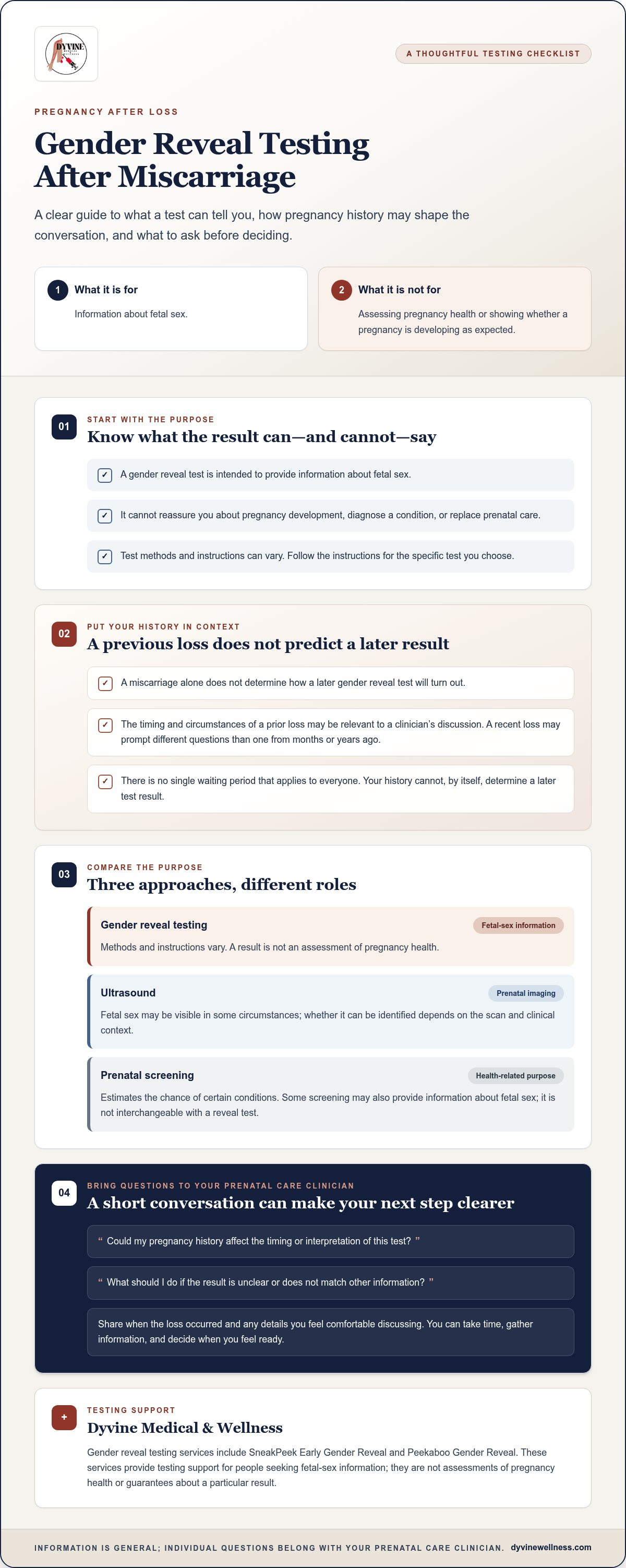
Questions to Consider Before Taking a Gender Reveal Test
There’s no universal right time to learn fetal sex. After a pregnancy loss, the decision may carry extra meaning. Taking a moment to consider what would feel supportive can help you decide whether to test now, wait, or not test.
Prepare for the decision and the result
Before scheduling a test, consider how receiving the result might feel today. Would knowing feel meaningful, or might it add stress? You don’t need to predict every emotion. The goal is to give yourself room to notice what matters to you.
Think, too, about who will receive or share the result. You might want to learn it privately, tell a partner first, or wait until you feel ready to share it with family. Deciding on those boundaries in advance can help keep the experience personal.
Use these questions as a starting point:
What do I hope learning fetal sex will offer me right now?
Would I prefer to receive the result privately or share it with someone?
How would I like to respond if the result is unclear or not what I expected?
Would waiting feel more comfortable, or does learning now feel meaningful?
Your answers do not have to be a commitment. You can change your mind. Choosing to wait, or not to test, is as valid as choosing to learn now.
Discuss personal medical questions with the right clinician
If your previous loss raises questions about timing, test interpretation, or your current pregnancy, discuss them with your prenatal care clinician. The details of your history are personal, and a clinician familiar with your care can help you understand what may be relevant. This article provides general information, not an interpretation of your history or individualized medical advice.
To make the conversation easier, jot down your questions. You could mention when the loss occurred, share any details you feel comfortable discussing, and ask whether your history affects your plans for testing. You can also ask what to do if a result is unclear. You don’t need special terminology; a direct question is enough.
If you decide to proceed, follow the selected test’s current instructions for preparation and collection. Instructions for one test may not apply to another. For anyone considering a gender reveal test with previous miscarriage in their history, following the test instructions and discussing medical questions with a prenatal care clinician can help make the decision feel informed rather than rushed.
If professional testing and coordination support feels right for you, explore gender reveal testing with Dyvine Medical & Wellness.
Explore Gender Reveal Testing With Dyvine Medical & Wellness
After learning what gender reveal testing can and cannot tell you, you may decide that learning fetal sex feels like a meaningful next step. You may also want more time. Either choice deserves care, particularly if a previous pregnancy loss makes this moment feel tender or uncertain.
What DMW offers for gender reveal testing
Dyvine Medical & Wellness offers SneakPeek Early Gender Reveal and Peekaboo Gender Reveal. These services are options for people seeking information about fetal sex, with professional testing support. Each test has its own instructions, so follow the directions for the option you select rather than assuming the process or requirements are identical.
DMW provides testing and coordination support, not pregnancy health assessments or a replacement for guidance from your prenatal care clinician. Bring questions about your pregnancy history, test interpretation, or prenatal screening to the clinician involved in your care. A gender reveal result is one piece of information, not a complete picture of your pregnancy.
For an overview of the options and related details, visit the gender reveal testing services page. Understanding the service and its instructions can help you make a considered decision.
A supported next step in Georgia
Dyvine Medical & Wellness serves clients in Stockbridge, Atlanta, McDonough, Jonesboro, Decatur, Covington, Conyers, Jackson, Macon, Columbus, Lawrenceville, Snellville, Buford, Sugar Hill, Griffin, Senoia, Peachtree City, and Fayetteville. For people in these Georgia communities who choose to proceed, DMW offers gender reveal testing and coordination support. You can keep the experience private, share the news with loved ones, or wait until you feel ready. There’s no need to turn a personal decision into a deadline.
When you’re ready, visit www.dyvinewellness.com to explore the service and take your next step. You can review the information at your own pace before deciding.
Considering a gender reveal test with previous miscarriage in your history can bring practical questions and personal feelings. Dyvine Medical & Wellness provides a client-focused testing option without promising a particular result. Your prenatal care clinician remains the right person for individualized medical guidance. All medical services are provided in accordance with applicable regulations. Dyvine Medical & Wellness provides specimen collection, education, and coordination services.
Make Space for the Next Step That Feels Right
A new pregnancy can bring more than one feeling at once. You can welcome curiosity, keep parts of the experience private, and let your comfort level change over time. You don’t need to make a decision to fit someone else’s timeline.
If you’re weighing a gender reveal test with previous miscarriage in your history, let your next step reflect both your questions and your boundaries. Write down what you’d like to know, consider who you want beside you, or give yourself more time. Bring medical questions to your prenatal care clinician. When you feel ready to explore testing, choose an option that respects your pace.
Frequently Asked Questions
Can a gender reveal test be wrong after a previous miscarriage?
Yes. A result can be incorrect or unclear, and a previous loss alone cannot predict what will happen. The timing and circumstances of the loss, the current pregnancy, and the specific test may all be relevant to a clinician’s discussion. If you’re considering a gender reveal test with previous miscarriage in your history, share that context with your prenatal care clinician and follow the selected test’s current instructions.
Known reasons a blood-based fetal-sex result may not match the baby's sex include testing too early, a "vanishing twin" (when a pregnancy began as twins and one stopped developing early, and DNA from that twin is still in the blood), and less common chromosome or genetic differences in the pregnant person or the baby. If you've had bleeding or an early ultrasound that showed more than one gestational sac, tell your prenatal care clinician before relying on a fetal-sex result.
Does a gender reveal blood test determine whether a pregnancy is healthy?
No. A gender reveal blood test is not designed to assess overall pregnancy health or diagnose a condition. A result indicating fetal sex cannot confirm how a pregnancy is developing. If you have symptoms or concerns about your wellbeing or the pregnancy, contact your prenatal care clinician rather than using a reveal result to make health decisions.
Call your prenatal care clinician right away if you have vaginal bleeding, cramping, or pass tissue or clots. Call 911 or go to the nearest emergency room if you have heavy bleeding, severe pain in your belly, pelvis or shoulder, or you feel faint or dizzy. No test result, normal or otherwise, is a reason to wait.
Can a gender reveal test identify fetal sex before an ultrasound?
It may provide information before an ultrasound offers a view of fetal sex, depending on the test and the timing of both. There isn’t one timeline that applies to every test or scan, so an early result should not be treated as guaranteed. If you’re planning around an appointment or announcement, follow the selected test’s instructions and discuss timing with your prenatal care clinician.
Should I tell my prenatal care clinician about a previous miscarriage before testing?
Sharing your pregnancy history can help your clinician respond to questions about your individual situation. You might mention when the loss occurred and ask whether it has any bearing on the test you’re considering. For people in Stockbridge, Atlanta, McDonough, and nearby Georgia communities, medical questions about testing are best discussed with the clinician involved in your prenatal care.
Can a gender reveal test result differ from a later ultrasound?
Yes, results can differ. An ultrasound may not provide a clear view, and tests can have limitations or produce an unclear result. If the information doesn’t match, avoid drawing conclusions from the difference alone. Keep any report or test details and bring them to your prenatal care clinician, who can explain what follow-up, if any, is appropriate for your circumstances.
A mismatch is worth mentioning to your clinician rather than ignoring, because occasionally it points to something they'll want to look into.
What should I do if a gender reveal test result causes concern?
Pause before acting on the result, and contact your prenatal care clinician if it raises a medical question or causes distress. Keep the result and any information about the test so you can explain what prompted your concern. If you feel emotionally overwhelmed, consider reaching out to someone you trust for support while you decide what you need next.
Your prenatal care clinician can also connect you with support after pregnancy loss. If you're in emotional distress or having thoughts of harming yourself, you can call or text 988 to reach the 988 Suicide & Crisis Lifeline, which is free, confidential, and available 24/7.
Can a gender reveal test be used instead of prenatal screening?
No. A gender reveal test is not a substitute for prenatal screening or other care recommended by your clinician. These services have different purposes, and a reveal result does not answer screening questions about pregnancy health. If you’re deciding whether to take part in screening, ask your prenatal care clinician about the available options and what each is intended to tell you.



Comments