

Legal Implications of Paternity Test Results in Georgia: What a Result Can and Can't Do

When you're waiting on a paternity test, it's natural to hope the result will settle everything. A DNA result can answer an important question, but it doesn't always answer every question.
Here's the difference between what a test shows and what the law decides, and why choosing the right kind of test matters from the start.
This article is general information, not legal advice. If your situation involves custody, child support, a birth certificate, an existing court order or a signed acknowledgment of paternity, talk with a Georgia family law attorney before you test.
Biology and legal parentage are two different questions
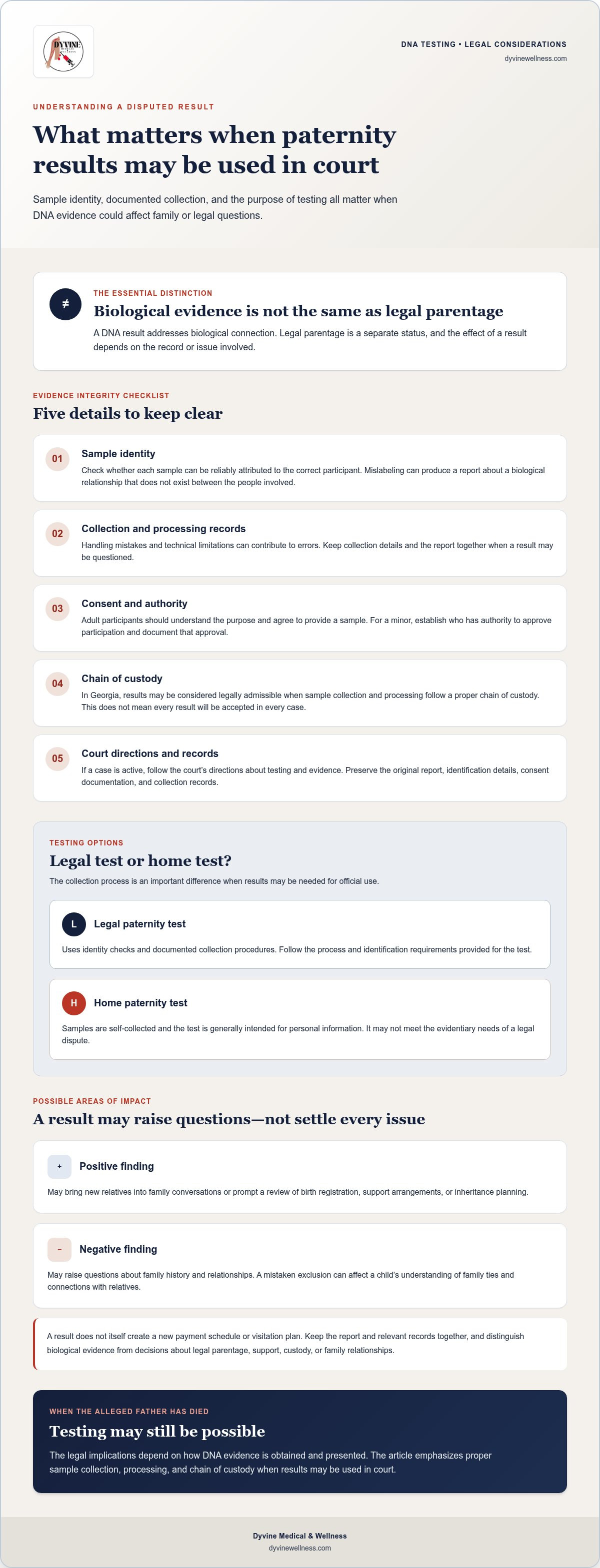
A paternity test looks at DNA to show whether a biological relationship is likely. Legal parentage is a person's recognized status as a child's parent. It can come from a court order, a signed acknowledgment or other legal steps.
A DNA result can be important evidence. But it doesn't, on its own, change a birth certificate, end a support order or decide custody. Those decisions go through the legal process, and the court decides how a result is used.
Legal vs. peace-of-mind testing
There are two kinds of paternity tests, and they are not interchangeable.
Peace-of-mind testing is for your own knowledge. It isn't for court or other legal use.
Legal testing follows a documented chain-of-custody process. Each person's identity is checked, and the collection and handling of every sample is recorded. Legal DNA testing is processed by an AABB-accredited laboratory. Choose it when results may be needed for court, child support, custody, a birth certificate or immigration.
A peace-of-mind result generally can't be upgraded to a legal one later. If there's any chance you'll need the result officially, choose legal testing from the start.
Where a result may come up
Depending on your situation, a paternity result may come up in:
Child support matters
Custody or visitation
Birth certificate questions
Inheritance or family records
Immigration cases, which have their own requirements, so tell us up front
In every one of these, the result is evidence. The decision belongs to the court or agency.
If a court has ordered testing
Follow the court's instructions about who must be tested, where and by when. If you have a concern about the order, raise it with your attorney rather than skipping the test. A private test you arrange on your own doesn't replace the testing the court ordered.
If parentage is already established
If a father is already legally recognized, for example through a court order or a signed acknowledgment, a new DNA result doesn't automatically change that. The rules and deadlines for challenging parentage in Georgia depend on how it was established. That's a question for a Georgia family law attorney.
Talking with your family
A result can affect relationships, not just records. Keep adult disagreements away from children, and give everyone time to process. A family counselor can help if conversations get hard.
Paternity testing at Dyvine Medical & Wellness
We offer legal and peace-of-mind paternity testing, with collection at our Stockbridge office. Standard paternity testing typically uses a gentle cheek swab. Results are released only to authorized parties, and we'll confirm expected timing when you book.
If the alleged father can't take part, other relationship tests may help, such as grandparentage, siblingship or avuncular DNA tests.
What to bring: a government photo ID for each adult, a legal guardian for any minor, and any court or agency paperwork.
Current pricing is shown when you book online. Learn more about DNA paternity testing or book a paternity test.
Dyvine Medical & Wellness, 9070 Peridot Parkway, Stockbridge, GA 30281. Monday to Friday, 10 am to 5 pm. Saturday by appointment only. Please book at least 24 hours ahead.
Frequently asked questions
Does a paternity test result change legal parentage automatically? No. A result is evidence about biology. Changing legal parentage goes through the legal process. Talk with a Georgia family law attorney.
Can a home test be used in court? A self-collected home test doesn't follow a chain-of-custody process, so it generally isn't suitable for court. If you may need the result legally, choose a legal test.
What makes a paternity test "legal"? Identity checks for each person, documented collection and handling (chain of custody), and processing by an AABB-accredited laboratory.
What if a court ordered the test? Follow the court's instructions, and talk with your attorney about any concerns.
Do you offer at-home or mobile DNA collection? No. DNA samples are collected at our Stockbridge office.
This article is for general information only and is not legal advice. Dyvine Medical & Wellness provides DNA sample collection. Analysis is performed by a laboratory partner. We do not provide legal advice or interpret results.



Comments