

Women's Hormone Blood Tests in Henry County: A Guide

What if the most useful first step in hormone testing is clarifying the question you want it to answer? If you’re considering a hormone level blood test for women Henry County, it’s understandable to want clear guidance on which tests may fit your concerns and whether timing could affect collection. Hormone results can provide information, but they don’t tell the whole story or replace a healthcare provider’s assessment.
This guide explains what hormone blood tests may measure, what to discuss with the healthcare provider ordering your tests, and how to plan for collection. We’ll cover why the reason for testing matters, when menstrual cycle timing or preparation instructions may be relevant, and what to know about the limits of results. For provider-directed testing, Dyvine Medical & Wellness provides mobile and in-house phlebotomy and specimen collection services, with options designed to fit your routine.
Table of Contents
What Can a Hormone Level Blood Test Tell Women in Henry County?
A hormone level blood test measures selected hormones in a blood sample. Results give a healthcare provider information to consider, but they are only one part of understanding your health. The reason for testing guides which measurements a provider may order, and a blood test alone can’t explain every symptom or diagnose every condition.
Results need to be considered alongside your health history and other clinical information. For background on one hormone that may be measured, read about understanding estradiol blood tests.
This video offers an educational overview of possible hormone-related signs and questions to discuss with a healthcare provider:
Which hormones may a provider include in testing?
Depending on the clinical question, a provider may order tests for estradiol, progesterone, FSH, or LH. These are examples, not a universal panel or a recommendation for every woman. The healthcare provider determines which measurements, if any, fit the reason for testing.
Why symptoms and results need clinical context
Age, menstrual cycle stage, and health history can influence how results are considered. Share relevant details with the provider ordering your tests. That provider is responsible for interpreting results and discussing their meaning. Specimen collection supports the testing process; it isn’t medical interpretation or diagnosis.
Test selection depends on the clinical question, and results should be understood in the context of each person’s health history and symptoms.
Dyvine Medical & Wellness provides mobile and in-house phlebotomy and specimen collection services for provider-directed testing. Learn about professional phlebotomy services in Henry County.
How to Choose the Right Hormone Blood Tests for Your Situation
A useful testing plan starts with a clear question, not a guess at which panel to order. Your healthcare provider should determine which tests are appropriate for your situation. You can help by sharing what you’ve noticed, clarifying the instructions, and arranging collection for the tests that have been ordered.
Start with the reason for testing
Routine wellness questions and symptoms that need clinical evaluation may lead to different conversations. Before speaking with your provider, write down what prompted your questions, when symptoms occur, and what you hope to understand. This record can guide the discussion, but symptoms alone can’t identify a hormone issue or tell you which test to order.
Share relevant cycle information and health history, including changes in menstrual patterns or other details your provider asks about. You don’t need to arrive with a diagnosis or a preferred panel. Give your provider a clear picture so they can consider whether testing is appropriate and which measurements may help address the clinical question.
Confirm the test order and collection instructions
Once your provider has selected tests, follow the order and instructions for each one. Timing and preparation can differ. Some testing may be scheduled around cycle information, while other tests may have different directions. Don’t assume you need to fast, change your routine, or choose a collection date without guidance. If an instruction is unclear, clarify it with the provider who ordered the tests before your appointment.
At-home options have a different purpose and process from a provider-directed blood draw. The U.S. Food and Drug Administration explains how at-home FSH tests are intended to help indicate whether someone may be in menopause or perimenopause. That information doesn’t replace a provider’s assessment or determine which tests are right for you.
For broader context on wellness testing, explore Dyvine Medical & Wellness’ comprehensive wellness panels. For hormone testing ordered by your provider, keep collection aligned with that order. Dyvine provides mobile and in-house phlebotomy and specimen collection services for Henry County clients.
Compare Test Scope, Timing, and Collection Before Booking
Before arranging a hormone blood draw, make sure the test order, timing instructions, and collection plan fit together. Clarifying these details can prevent confusion on appointment day. Your healthcare provider interprets results in light of your individual circumstances; a lab result by itself isn’t a diagnosis or treatment plan.
What to compare
What to clarify
Test scope
Which tests are on the provider’s order, and what clinical question are they intended to inform?
Timing
Does the ordering provider specify timing based on your cycle or another factor?
Collection logistics
Would in-house or mobile collection better fit your location, schedule, and instructions?
How timing can affect a hormone blood test
Timing requirements depend on the test and the reason it was ordered. Some hormone results may be considered in relation to menstrual cycle timing, while other tests may come with different instructions. There isn’t one cycle day or schedule that applies to everyone or every order. Follow the specific guidance from the healthcare provider who ordered your tests, and clarify any uncertainty before booking.
Keep the order and instructions accessible as you plan. If timing changes or you’re unsure whether a collection date fits the directions, consult the ordering provider rather than adjusting the plan yourself.
What to compare when arranging specimen collection
Mobile and in-house phlebotomy are collection options, not different ways to interpret or diagnose a health concern. Consider which setting fits your routine and makes appointment logistics easier. Dyvine Medical & Wellness provides professional specimen collection services in Henry County, with mobile and in-house phlebotomy for provider-directed testing. Learn more about mobile and in-house phlebotomy.
The same hormone result can have different significance depending on a person’s symptoms, health history, and clinical context. For general background on symptoms and hormone changes, Cleveland Clinic offers an overview of Hormonal Imbalance. Keep the provider’s instructions at the center of your plan, then choose a collection option that works for your day.
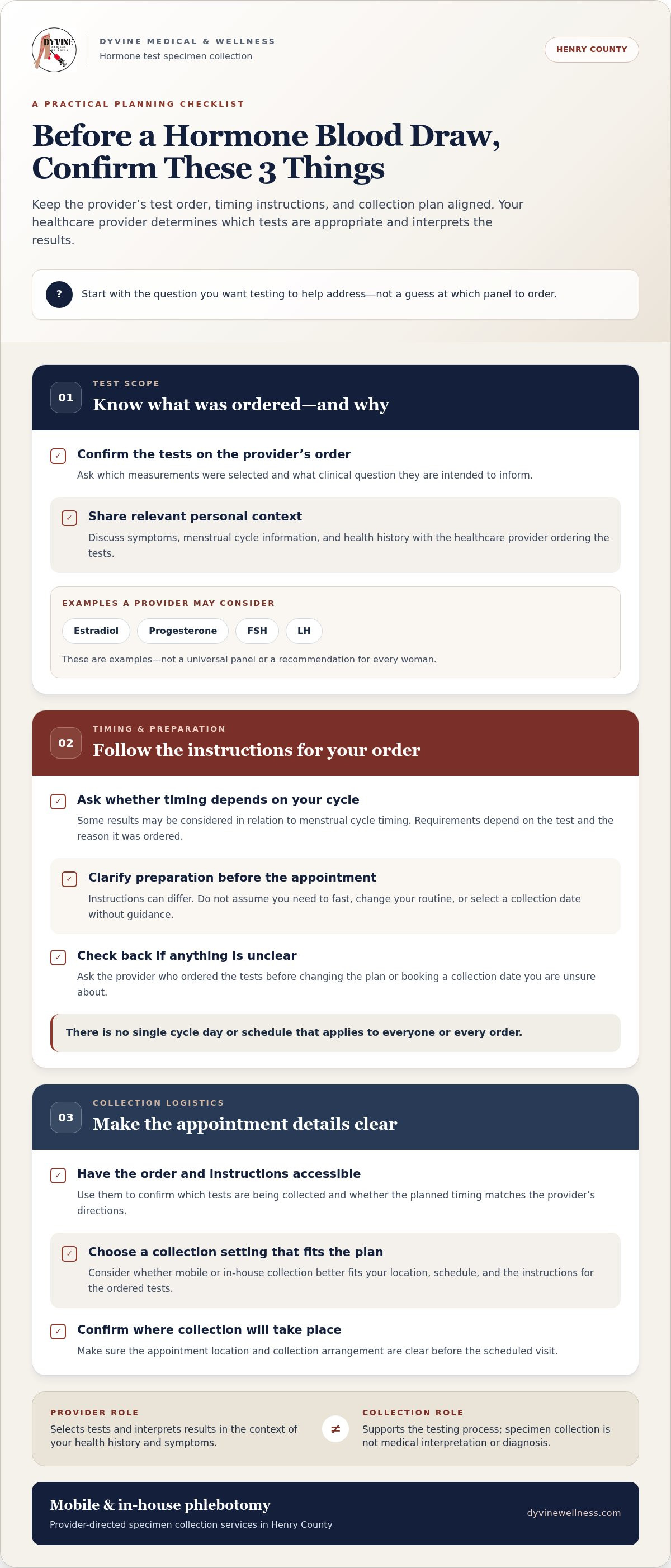
Prepare for a Hormone Blood Test in Henry County
A little preparation can make collection day more straightforward. Review the instructions for your specific order, confirm the appointment details, and decide whether mobile or in-house collection better suits your plans. Keep your test order and preparation guidance together so the collection details are clear.
What to do before your collection appointment
Start by reviewing the instructions from the healthcare provider who ordered your tests or the laboratory handling them. Requirements can vary. Don’t assume you need to fast or change your usual routine; follow only the directions given for your tests. If something is unclear, contact the ordering provider before collection.
When arranging collection, have the exact test order and its instructions available. Confirm your appointment details and collection location, then consider whether mobile or in-house phlebotomy fits your schedule and needs. Clear information helps align collection with the order and avoids guesswork.
Keep the test order and instructions accessible.
Confirm your appointment details and collection location.
Follow test-specific preparation guidance from your provider or laboratory.
What happens during specimen collection
A collector follows the instructions for the ordered tests and draws the blood sample. You can ask questions about the collection process and share any concerns. After collection, the specimen proceeds through the relevant testing process. Discuss results and their meaning with the healthcare provider who ordered the tests.
Dyvine Medical & Wellness provides mobile and in-house phlebotomy and specimen collection services for clients in Henry County and Stockbridge. Learn more about mobile phlebotomy and in-house collection. Choosing an option that fits your location and schedule can make this step easier to manage.
For professional specimen collection support, schedule your collection with Dyvine Medical & Wellness.
Arrange Professional Hormone Test Specimen Collection with Dyvine
Once your healthcare provider has ordered hormone testing and explained any timing or preparation instructions, arrange collection in a way that works for you. Dyvine Medical & Wellness provides mobile and in-house phlebotomy and professional specimen collection services, supporting provider-directed testing in Henry County and across its Georgia service area.
What Dyvine’s specimen collection support is designed to do
Dyvine supports the collection process. Your ordering provider determines which tests are appropriate and interprets the results in the context of your health. Specimen collection is not clinical diagnosis or treatment. This distinction keeps each part of your testing process clear.
With mobile and in-house options, collection can be arranged around practical needs such as your schedule and preferred setting. It’s convenience without compromising professionalism. Bring or share the exact test order and instructions so collection can follow the provider’s directions.
All medical services are provided in accordance with applicable regulations. Dyvine Medical & Wellness provides specimen collection, education, and coordination services.
Choose a convenient next step in Henry County
Explore Dyvine’s professional phlebotomy services to learn about mobile and in-house collection. For a broader look at wellness testing, read the comprehensive wellness panels guide. These resources can help you understand collection options while your provider guides test selection and results.
Dyvine serves Stockbridge, Atlanta, McDonough, Jonesboro, Decatur, Covington, Conyers, Jackson, Macon, Columbus, Lawrenceville, Snellville, Buford, Sugar Hill, Griffin, Senoia, Peachtree City, and Fayetteville. Visit Dyvine Medical & Wellness to schedule or learn more.
Take the Next Step with Confidence
A thoughtful testing plan begins with your reason for testing and the guidance of the healthcare provider who orders it. Test selection, timing, and preparation can vary, so follow the instructions specific to your order and discuss results with your provider. A hormone level blood test for women Henry County is one part of a broader health conversation, not a diagnosis on its own.
Dyvine Medical & Wellness supports provider-directed testing with mobile and in-house phlebotomy, professional specimen collection and coordination, and comprehensive wellness panels. These services are designed to make collection more convenient while keeping test decisions and result interpretation with your healthcare provider.
When you’re ready to arrange collection or learn more, schedule professional specimen collection with Dyvine. Take the next step with clear instructions and professional support.
Frequently Asked Questions
How do I know which hormone blood tests to ask about?
The appropriate tests depend on your health question, so discuss test selection with the healthcare provider who would order them. Describe your concerns and share relevant health history, including changes in your menstrual cycle. This article offers general education; it can’t diagnose a concern or choose tests for you. There isn’t one universal hormone panel that’s right for every woman.
Can hormone levels change during the menstrual cycle?
Yes, some hormone measurements can vary with menstrual cycle timing. Requirements depend on the particular test and the clinical question being considered. Follow the collection instructions from the provider who ordered your test rather than assuming one cycle day applies to everyone. If you’re uncertain about when to schedule collection, clarify the instructions with your provider before arranging your appointment.
Do I need to fast before a hormone blood test?
Preparation depends on the specific tests ordered. Don’t assume fasting is required or unnecessary for every hormone blood test. Follow the directions from your ordering healthcare provider or laboratory, and have those instructions available when arranging specimen collection. If you’re unsure what an instruction means, ask the ordering provider for clarification. Avoid changing your usual routine unless you’ve been specifically instructed to do so.
Can a hormone blood test explain symptoms by itself?
No. A laboratory result is one part of a broader clinical picture and doesn’t independently diagnose every possible cause of symptoms. The healthcare provider who ordered the test interprets the result alongside your health history and other relevant information. Bring questions about symptoms and results to that provider. A single result should not be treated as confirmation of a specific condition on its own.
Can I arrange a mobile hormone blood draw in Henry County?
Yes. Dyvine Medical & Wellness provides mobile and in-house phlebotomy and professional specimen collection services. For a hormone level blood test for women in Henry County, have your test order and collection instructions ready when arranging a visit. Dyvine serves Stockbridge and communities across its Georgia service area, including McDonough, Atlanta, Jonesboro, Conyers, and Fayetteville.
What happens after my hormone blood sample is collected?
After collection, the specimen proceeds through the applicable testing process, and results are handled according to the relevant arrangements. Dyvine provides specimen collection, education, and coordination services. The healthcare provider who ordered your tests interprets the results and discusses any next steps with you. Dyvine doesn’t diagnose or treat conditions. Direct questions about what your results mean to your ordering provider.


Comments