

Understanding Lab Results: A Clear Guide to Ranges, Flags, and Next Steps

Updated: Oct 20
What if an out-of-range flag is a prompt for a question, not a reason to assume the worst? Unfamiliar terms and numbers can feel unsettling without context. Understanding lab results starts with treating each value as information to discuss, not a stand-alone verdict.
This guide explains common report details, why reference ranges vary, and what to ask the clinician who ordered your test. Dyvine Medical & Wellness provides blood draws and specimen collection support. Your clinician interprets your results.
Table of Contents
Understanding Lab Results Starts With the Test Name and Its Purpose
An unfamiliar report can make even a routine test feel difficult to understand. Abbreviations, numbers, and flags may appear before you speak with the clinician who ordered the test. Start by identifying what was tested and why, then read the result in that context. This guide offers a practical place to begin understanding lab results without treating one number as a final answer.
A laboratory test analyzes a collected sample, such as blood, to measure or examine particular substances or characteristics. The test name tells you what kind of information the report contains. Before focusing on a value, locate the test name and, if available, the reason it was ordered.
For a visual overview of common blood test panels, watch this educational video:
What the test name tells you
Different tests examine different parts of a sample, so their results answer different questions. A complete blood count (CBC) examines components of blood cells, while a comprehensive metabolic panel (CMP) measures a group of substances in the blood. These are distinct panels, not interchangeable sets of numbers. Knowing which test you’re viewing helps you understand what its values describe and which questions to bring to your clinician.
Blood collection and report interpretation are separate steps. Dyvine Medical & Wellness provides blood draw and specimen collection services. The clinician who ordered your test is the person to ask what its findings mean for you.
A practical first look
Use this sequence to orient yourself before reviewing individual entries:
Find the test name. Note whether the report shows a single test or a panel, such as a CBC or CMP.
Recall the reason for testing. Consider what concern, routine check, or follow-up led to the order.
Mark what you want clarified. Write down unfamiliar terms or results to discuss with the ordering clinician.
Why a result needs context
A report shows measurements from a sample, but it doesn’t contain your full health story. Your health history, symptoms, and reason for testing all matter when a clinician reviews the findings. The ordering clinician can connect the results with that broader clinical picture and determine whether follow-up is appropriate. Avoid drawing a conclusion from one entry or comparing your report with someone else’s.
One lab result alone cannot establish a diagnosis. It is one piece of information to discuss alongside the circumstances of the test and other relevant clinical details. If a result worries you, note the test name and your question, then raise them with the clinician who ordered it. A clear conversation can turn an unfamiliar report into a more useful next step.
How Reference Ranges and Out-of-Range Flags Should Be Read
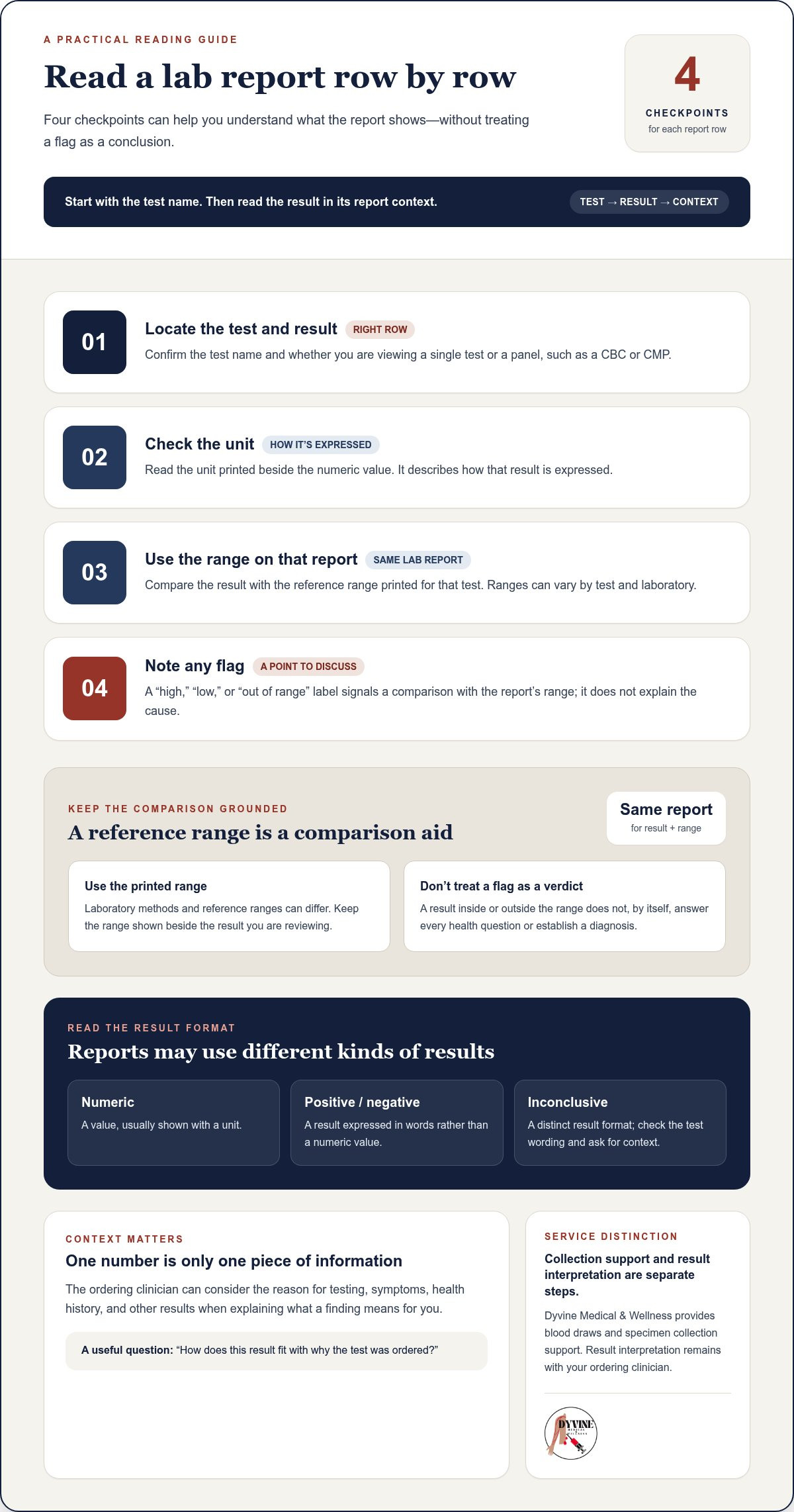
Once you’ve identified the test, read across its row rather than focusing on a flag alone. A report commonly lists the result, its unit, a reference range, and sometimes a label such as “high,” “low,” or “out of range.” Layouts differ, so check the column headings and make sure each item belongs to the correct test.
Use this sequence:
Locate the test and result. Confirm you’re reading the correct row.
Check the unit. It describes how the numeric value is expressed.
Find the report’s reference range. Compare the result with the range printed for that test.
Note any flag. Record it as a point to discuss, not a conclusion.
Keep the report’s range beside its result. Ranges can vary by test and laboratory, so a cutoff from another report or an online example may not be a useful comparison. Even reports with the same test name can show different ranges when laboratory methods differ.
What a reference range means
A reference range is the comparison range the laboratory prints for a specific test. It helps show how a result compares with that laboratory’s stated range, but it doesn’t describe your individual health on its own. When understanding lab results, use the range on the same report as the result. Don’t apply figures from another lab or a general webpage as though they were universal thresholds.
A reference range is a comparison aid, not a diagnosis. A result inside the range doesn’t answer every health question, and a result outside it doesn’t automatically mean disease is present. The ordering clinician can explain how the finding relates to your reason for testing and overall situation.
What high, low, and flagged results can signal
A “high” or “low” label indicates that a result falls above or below the reference range shown for that test. A flag draws attention to the comparison; it doesn’t explain the cause or establish what the result means for you. The clinician may consider symptoms, health history, the reason for testing, and other results before deciding whether follow-up is needed.
Make a note of the test name, result, unit, range, and flag, then bring those details to the ordering clinician. Don’t diagnose yourself from the label or change your care based on a flag alone. If you’re unsure what to ask, start with: “How does this result fit with why the test was ordered?”
If a clinician has ordered a blood test and you need collection support, Dyvine Medical & Wellness offers in-house and mobile phlebotomy services. Dyvine provides specimen collection and coordination support; result interpretation belongs with the ordering clinician.
Read the Result in Context: Units, Trends, and Uncertainty
Lab reports can present findings in different formats, and the format shapes how you read an entry. Some results are numbers paired with units; others use words such as “positive,” “negative,” or “inconclusive.” Understanding lab results means first recognizing the type of result, then considering what it can and can’t tell you.
Numeric results versus positive or negative results
A numeric result gives a value, usually alongside a unit. A positive or negative result uses a label whose meaning depends on the specific test and what it is designed to assess. An inconclusive result means the report doesn’t provide a clear answer in that format. These examples show the difference, not how to interpret any particular test:
The sample number and wording above are generic examples, not medical thresholds or interpretations. A positive label isn’t automatically a measure of severity, and “negative” doesn’t explain every aspect of a person’s health. If the report uses an unfamiliar term, note the exact wording and ask the clinician who ordered the test to explain it in context.
Why units and previous results matter
A unit tells you how a numeric value is expressed. Two numbers can look similar but represent different measurements if their units differ. Read the result with the unit and reference range printed beside it. Don’t compare values from different reports without checking those details.
Compare results only with the range and units on that report. This anchors the comparison to the information provided for that particular test, rather than an unrelated example or a number remembered from elsewhere.
Earlier results may help the ordering clinician assess change over time, especially when the same test has been repeated. A single report is a snapshot; a series of results may offer additional context. A trend isn’t a diagnosis on its own. The clinician may consider why each test was ordered and how the findings relate to your health history, symptoms, and other information.
If a result is unclear, unexpected, or marked inconclusive, note the test name, exact wording, value and unit if shown, and any questions that come to mind. Then discuss them with the ordering clinician. Dyvine Medical & Wellness supports blood draws and specimen collection; interpretation belongs with the clinician responsible for your care.
What to Do After Reading a Lab Report
A report can provide useful information, but it may not explain what a result means for your individual situation. An organized review can help you prepare for a clear conversation with the clinician who ordered the test. You don’t need to interpret every line on your own.
Use this sequence to get ready:
Identify the test. Note its name and, if you know it, why it was ordered.
Record the result and range. Copy the wording, value, unit, reference range, and any flag exactly as shown.
Write down your questions. Include unfamiliar terms, anything that surprised you, and what you hope to understand.
Keep the report available during your conversation, whether it’s on paper or in a patient portal. A little preparation can help you focus on what matters and leave with a clearer sense of the next step.
Questions to take to the ordering clinician
Ask which result is most relevant to the reason for testing and why. You can also ask how your symptoms, health history, or other findings affect the clinician’s interpretation. If any wording remains unclear, request an explanation in everyday language. These questions support understanding lab results without asking you to diagnose yourself.
How does this result relate to the reason the test was ordered?
Do my symptoms, history, or other results change how you view it?
Is repeat testing or another follow-up recommended for my situation?
Who should I contact if I have questions after this conversation?
If follow-up is recommended, ask what it involves and who will explain the relevant findings. The clinician can advise whether repeat testing or another step is appropriate; don’t treat an online explanation as a personal care plan. Avoid changing your care based solely on what you read online. If you’re uncertain, seek guidance from the clinician responsible for your care.
When the report is unclear or delayed
If the report uses wording you don’t understand or you’re unsure what to do next, contact the ordering practice for clarification. If you’re waiting for a report, ask the appropriate office about its status. Result timing varies by test type and is confirmed at booking, so don’t assume every test follows the same schedule.
Dyvine Medical & Wellness provides specimen collection support, not diagnosis or interpretation of lab results. For blood draw and lab collection services, learn about Dyvine’s services and schedule an appointment. Keep questions about results with the ordering clinician, who can interpret the report in relation to your circumstances.
Lab Collection Support in Stockbridge: What Dyvine Can Help With
Dyvine Medical & Wellness provides blood draws, lab collections, wellness panels, and specimen collection support in Stockbridge. In-house and mobile phlebotomy offer collection options for many testing services. These services support specimen collection, not diagnosis or interpretation. For help understanding what a report means for your health, speak with the clinician who ordered the test.
In-house and mobile specimen collection
Choose in-house phlebotomy or mobile collection based on your needs and the service involved. Mobile visits are available for most testing services, including blood draws and lab collections, for an added fee. Both options focus on collecting specimens. Learn about blood draw and phlebotomy services to explore collection support.
Dyvine’s private collection rooms provide an in-office setting. Results are released only to authorized parties. HSA/FSA cards are accepted for eligible services.
Planning a collection appointment in Stockbridge
Dyvine Medical & Wellness is located at 9070 Peridot Parkway, Stockbridge, GA 30281. Office hours are Monday to Friday, 10 am to 5 pm, and Saturday by appointment only. Appointments are recommended. Contact Dyvine for current availability before planning your visit.
Bring a valid government-issued photo ID and any relevant paperwork for your test. If you’re unsure which documents apply, contact Dyvine before your appointment.
Text: 770-407-7011
Call: 470-726-2059
Use either contact method to ask about appointment availability and collection details. You can also schedule a specimen collection appointment. A little preparation can help make the collection process more organized.
After collection, direct questions about a report’s values, flags, or significance to the ordering clinician. Dyvine provides specimen collection and coordination support, while interpretation remains with that clinician. Dyvine serves clients in Stockbridge and nearby communities, including Atlanta, McDonough, Jonesboro, Decatur, Covington, Conyers, Jackson, Macon, Columbus, Lawrenceville, Snellville, Buford, Sugar Hill, Griffin, Senoia, Peachtree City, and Fayetteville.
Move Forward With Clear Questions
Understanding lab results means learning what the report shows and discussing what it means for your circumstances. Keep your report close, note what remains unclear, and bring those questions to the clinician who ordered the test. A thoughtful conversation can help you understand the next step without asking you to interpret the findings alone.
If specimen collection is part of your care plan, Dyvine Medical & Wellness can support the collection process. The ordering clinician remains your resource for interpreting results and discussing any recommended follow-up.
Explore Dyvine’s specimen collection services and appointment options, and take your next step with calm, informed support.
Frequently Asked Questions
Can a lab result be abnormal without meaning I have a health condition?
Yes. An out-of-range result doesn’t establish a health condition by itself. The ordering clinician may consider it alongside your symptoms, health history, reason for testing, and other findings. If a value is flagged, ask whether it has significance in your situation and what, if anything, is recommended next. Don’t use the label alone to reach a conclusion about your health.
What does it mean when a lab result is marked inconclusive?
An inconclusive result means the test didn’t provide a clear answer in the format used. What happens next depends on the specific test and why it was ordered. Ask the ordering clinician what the result means, whether repeat testing or another follow-up is appropriate, and who will explain the next steps. An inconclusive finding isn’t proof of either a positive or a negative result.
Why do different laboratories show different reference ranges?
Laboratories may use different testing methods, equipment, or reference populations, so the ranges printed on reports can differ. If you have reports from different dates or labs, bring both to your clinician rather than relying on a range found online. The clinician can explain whether the results can be meaningfully compared, considering the test details and why each one was ordered.
Can I compare lab results if the units are different?
Don’t compare numeric values directly when their units differ. A value expressed in one unit may need conversion before it can be compared with another, and the matching reference ranges also matter. Keep the full reports together, including test names and units, and ask the ordering clinician whether the measurements are comparable. This helps avoid drawing conclusions from numbers that only look similar.
How long do lab results take?
Result timing varies by test type and is confirmed at booking. For a pending report, review the patient portal or instructions from the ordering practice for details about how results are shared. If the report isn’t available as expected, contact the ordering practice to ask about its status and how you’ll receive it. Once it arrives, direct questions about its meaning to the clinician who ordered the test.
What should I bring to a blood draw appointment?
Bring a valid government-issued photo ID and any relevant paperwork, such as documents supplied by an employer, court, or agency for your specific test. Check that the paperwork relates to the service being collected, and keep any instructions you received available. Appointments are recommended. For current availability or collection details, text 770-407-7011 or call 470-726-2059 before your visit.
Can Dyvine Medical & Wellness explain or diagnose my lab results?
No. Dyvine Medical & Wellness provides specimen collection and coordination support, not diagnosis or interpretation. Direct questions about what findings mean to the clinician who ordered your test. Dyvine serves Stockbridge and nearby Georgia communities, including Atlanta, McDonough, Jonesboro, Decatur, Covington, Conyers, Jackson, Macon, Columbus, Lawrenceville, Snellville, Buford, Sugar Hill, Griffin, Senoia, Peachtree City, and Fayetteville.



Comments