

What to Do If You Disagree With a Drug Test Result

Updated: Oct 20
What should you do if an unexpected drug test result could affect work or another important decision? Start by understanding what the result says and which review process applies. It’s natural to feel concerned, but a calm, organized response can help you get clear information about the next steps.
This guide explains what to gather, whom to contact, and how the process may differ for DOT and non-DOT testing. The right next step depends on the program that ordered the test, so avoid assuming every test follows the same procedure.
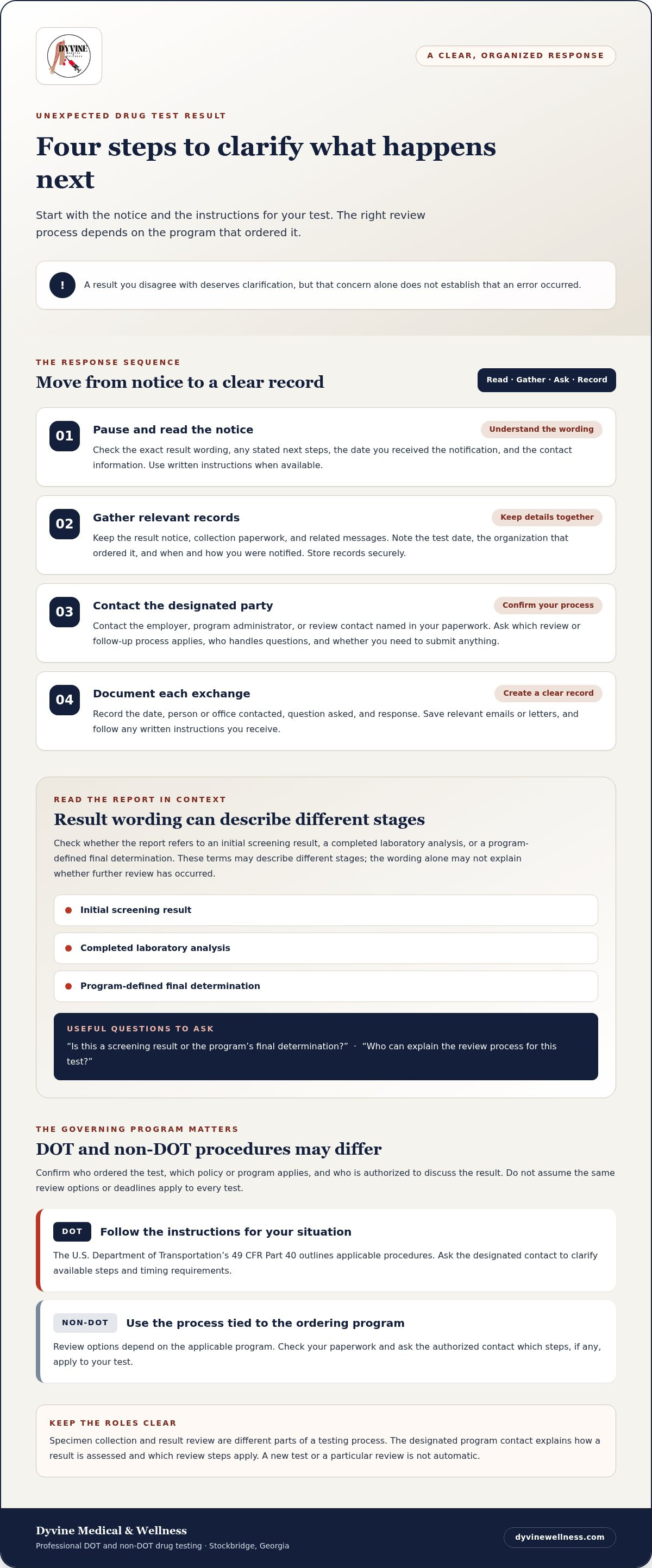
Table of Contents
First, understand what your drug test result actually says
An unexpected drug test result can feel unsettling, especially when work or another important decision may be affected. Before drawing conclusions, read the exact wording on the notice. A result that concerns you deserves clarification, but it doesn’t by itself establish that an error occurred or explain what happens next.
A disputed drug test result is one you believe needs clarification or review. That belief alone doesn’t prove the test was wrong. What happens next depends on the result’s status, the test method, and the rules of the program that ordered it. A drug test may use different specimen types and methods, so the report’s terms and context matter.
Screening result versus follow-up testing
Check whether the report describes an initial screening result, a completed laboratory analysis, or a program-defined final determination. These terms may refer to different stages, and the wording alone may not tell you whether further review has occurred. Follow-up or confirmatory testing depends on the applicable program. It isn’t automatically part of every test. Keep the report available and ask the designated contact to explain its status and what, if anything, follows.
Drug tests use set cutoff levels. A "positive" means the substance was found at or above the cutoff, and a "negative" can mean either none was found or the amount was below the cutoff. Quick screening tests can occasionally react to other substances, so a positive screen is usually followed by a more precise confirmation test. In DOT laboratory testing, a confirmation test is required whenever the first test is at or above the cutoff. Some non-DOT programs use only an on-site screen, so ask whether your result was confirmed.
Why the testing context matters
A test connected to a workplace, transportation role, court requirement, or another program may follow a specific process. Identify who ordered the test, which policy or program applies, and who is authorized to discuss the result. Those details help you direct your questions to the right person. Don’t assume every test offers the same review options or uses the same deadlines. Follow the instructions provided for your test.
As you review the paperwork, note the specimen type, test date, result wording, and any follow-up instructions. If something is unclear, ask focused questions: “Is this a screening result or the program’s final determination?” and “Who can explain the review process for this test?” Write down whom you spoke with and when. This creates a clear record without presuming an outcome.
It also helps to distinguish specimen collection from result review. A collection provider handles the collection process. The program’s designated reviewer or contact explains how a result is assessed and what review steps apply. Dyvine Medical & Wellness provides professional DOT and non-DOT drug testing. For questions about a particular result, use the authorized contact named in your paperwork. Results are released only to authorized parties.
Understanding the report is a practical first step in deciding what to do if you disagree with a drug test result. Some prescription and over-the-counter medicines, supplements, and foods can affect a screening test, which is one reason confirmation testing exists. Tell the collector or the MRO about everything you take, and have your prescription information ready for the MRO interview. Keep taking your prescribed medicines as directed. Don't stop or change a prescribed medicine because of a drug test without talking to the clinician who prescribed it.
For DOT tests, the MRO considers a legally valid prescription. However, DOT rules don't accept some common explanations, including hemp or CBD products for a marijuana result, coca tea for a cocaine result, poppy seeds when opiate levels are very high, or claims of unknowing or second-hand exposure. For non-DOT tests, ask what your program's reviewer will consider.
Steps to Take if You Disagree With a Drug Test Result
An unexpected result can create pressure to respond quickly. A calm, organized approach can help you understand the process and communicate your concern clearly. If you’re deciding what to do if you disagree with a drug test result, begin with the instructions for your test instead of assuming a particular review is available.
Pause and read the notice. Look for the exact result wording, any stated next steps, the date you received the notification, and contact information. Use written instructions when available rather than relying only on a brief verbal summary.
Gather relevant records. Keep copies of the result notice, collection paperwork, and messages related to the test. Note the test date, the organization that ordered it, and when and how you were notified. Store these details securely and share private information only through appropriate channels.
Contact the designated party. This may be an employer, program administrator, or named review contact. Ask which review or follow-up process applies, who handles questions about the result, and whether you need to submit anything. For a DOT test, this includes returning the MRO's call promptly.
Document each exchange. Record the date, the person or office you contacted, what you asked, and the response. Save relevant emails or letters, and follow any written instructions you receive.
Gather records and communicate clearly
Before reaching out, write a brief, factual summary of your concern. For example, you might say that you don’t understand the wording on the result notice or want to know whether a review step has taken place. Ask one question at a time, keep the tone respectful, and separate what you know from what you suspect. A clear written record can make follow-up easier.
Protect your privacy while organizing documents. Keep copies in a secure place and avoid sending sensitive records to people who aren’t involved in the process. If you speak by phone, note the key points afterward and ask how to receive or submit any required information in writing.
Ask about review or confirmation options
Direct your questions to the contact named in the paperwork or the organization that ordered the test. Ask what review or confirmation options apply, how to request one if available, and whether the program sets timing requirements or provides specific instructions. For DOT-regulated tests, a Medical Review Officer (MRO) reviews every laboratory-confirmed non-negative drug test before the result is reported to the employer. The MRO must try to speak with you directly and must give you the chance to explain whether there's a legitimate medical reason for the result, such as a valid prescription. Watch for that call, and respond promptly.
For non-DOT tests, whether there's an MRO or any review step depends on the employer's or program's policy, so ask the designated contact what applies.
For DOT testing, the U.S. Department of Transportation’s 49 CFR Part 40 outlines applicable procedures. Follow the instructions for your situation and ask the designated contact to clarify anything unclear. The responsible program should provide information about deadlines and available steps. Don’t rely on a general timeline from another type of test.
Two DOT timelines are worth knowing:
If your employer tells you to contact the MRO and you don't do so within 72 hours, the MRO may finalize the result without hearing from you. The MRO may also do so if no one can reach you within 10 days.
If you're explaining a result with a prescription, the MRO expects that information at the interview. The MRO may allow up to five days to produce records.
Keep your phone numbers current on the collection form, and check your messages.
Dyvine Medical & Wellness provides professional DOT and non-DOT drug testing, including specimen collection. For testing services, review the DOT and non-DOT testing information.
DOT or non-DOT drug test? Follow the process that applies
Before deciding which review steps to pursue, establish what kind of testing program governed the collection. A DOT test and a non-DOT test don’t necessarily use the same procedures. Dispute steps depend on the program that governs the test, so confirm which one applies before acting.
Look for language in the paperwork that identifies a DOT-regulated test or names the employer or program responsible for it. If the documents don’t make the distinction clear, ask the organization that ordered the test which process applies. A test associated with a transportation workplace doesn’t, by itself, establish which rules govern that particular test. Use the paperwork and the ordering organization’s guidance.
If the test is DOT-regulated
Applicable federal DOT procedures govern DOT drug testing. If your role is subject to DOT requirements, don’t treat testing as optional based on personal preference. Direct questions about the result or next steps to your employer or designated testing contact, and follow the instructions provided for your case. The process is specific, so avoid relying on general advice about a different kind of test.
If the test is non-DOT
For non-DOT testing, the employer’s or program’s policy sets the relevant process. Read the policy and result notice together, looking for who handles questions, which review options are described, and how to submit a request. If the instructions don’t address your concern clearly, ask the ordering organization to explain the applicable steps before you act. Don’t assume DOT procedures apply.
Federal agency workplace programs follow separate HHS Mandatory Guidelines. DOT tests follow 49 CFR Part 40 and are analyzed at HHS-certified laboratories. Other employer or program tests follow that organization's written policy and any state law that applies, and they may not include an MRO, a split specimen, or laboratory confirmation.
Keep the distinction clear in your communications. If your paperwork says DOT, ask for instructions under that process. If it identifies a non-DOT workplace or program test, ask about the policy-based procedure. This helps prevent a common source of confusion: using a deadline, review option, or expectation from one program to interpret another. The responsible organization can clarify which instructions apply to your result.
Dyvine Medical & Wellness provides professional DOT and non-DOT drug testing. Understanding the distinction between these services can help employers and individuals identify the testing context. Learn more about DOT and non-DOT drug testing.
Compare possible next steps before deciding what to request
Once you know which testing program applies, consider which action would address your concern. Asking for clarification, requesting an available review, and following written instructions serve different purposes. Let the notice and program process guide your decision rather than assuming a new test will be offered or change the result.
Ask for clarification if you’re unsure what a notice means, who handles questions, or which steps apply. This can help you understand the process before making a request.
Ask about an available review if the program’s instructions describe one. Find out how to submit a request and whether specific forms or timing requirements apply.
Follow written instructions if the notice calls for an action or identifies a designated contact. Keep a copy of the instructions and note when you respond.
A new test isn’t automatically available, and there’s no guarantee it will change an outcome. A repeat collection may not address a concern about how an earlier result was reviewed. Before requesting another test, ask the responsible program which options are available and what each is intended to address.
In DOT testing, if the MRO verifies a positive result (or a refusal because of adulteration or substitution), the MRO must tell you that you can ask for your "split specimen" (a separately sealed portion of your original collection) to be tested at a different HHS-certified laboratory. You have 72 hours from the MRO's notice to ask, and you can ask verbally or in writing. You don't have to pay before the test is done, although your employer may seek reimbursement afterward. If the second lab doesn't reconfirm the result, the test is cancelled. If it does, the original result stands. There's no split-specimen test for an "invalid" result.
In non-DOT testing, whether a split specimen exists, and how to request a retest, depends on the program's policy.
For DOT tests, a separate test you arrange yourself, at any testing provider, can't be used to challenge the original result. DOT rules require the MRO to disregard results from tests that weren't collected and tested under the DOT process. The split-specimen request described above is the DOT route.
For non-DOT tests, ask the employer or program, before paying for a new test, whether they would consider an independent result at all.
When to seek qualified advice
If a result could affect your job or another formal decision, consider talking with an employment attorney or another qualified legal professional about your situation. This article can't determine your rights or promise a particular outcome. Contact a regulator or program office when the testing instructions direct you there or the responsible program identifies it as the appropriate channel.
What a testing provider can and cannot do
Collecting a specimen is separate from interpreting or reviewing a result, deciding whether it is valid, or determining employment consequences. Dyvine Medical & Wellness provides DOT and non-DOT drug testing and specimen collection services. Questions about review or workplace decisions should go to the authorized parties identified by the applicable program. Results are released only to authorized parties.
Keeping these roles distinct can help you direct questions effectively: ask the collection provider about the collection process, and ask the designated program contact about review or policy. If you need testing for another reason, Dyvine's Stockbridge drug testing guide provides local context as you consider your testing needs. For service details, Dyvine also offers DOT and non-DOT drug testing.
Arrange professional drug testing support in Stockbridge, Georgia
Understanding a result and arranging a drug test are separate needs. Dyvine Medical & Wellness provides professional DOT and non-DOT drug testing in Stockbridge, Georgia, including specimen collection services. The collection provider’s role is separate from the process for reviewing or disputing a result. Follow the instructions from the authorized employer or program contact with questions about a specific outcome.
Appointments are recommended for new testing. Mobile and after-hours visits are offered for most testing services at an added fee. Contact Dyvine for current availability and to discuss the testing service that fits your employer, court, or agency instructions.
What to bring and what to expect
Bring a valid government-issued photo ID and any relevant paperwork from your employer, court, or agency. These documents can help the collection process follow the instructions for your test. If you’re unsure which paperwork applies, refer to the notice or directions provided by the organization that ordered the test.
Result timing depends on the test type. Rapid tests are faster, while lab-based and DNA tests take longer. Current pricing is displayed during online booking, so you can review the applicable information as you arrange your appointment. Avoid making plans based on an assumed result timeline. Follow the information provided for the specific test.
Book testing or learn about local services
Dyvine’s drug and alcohol testing services include DOT and non-DOT options. You can also book drug testing online and view current pricing during booking. A scheduled collection provides testing support, but questions about a prior result or its review should still go to the authorized contact for that program.
Visit: 9070 Peridot Parkway, Stockbridge, GA 30281Hours: Monday-Friday, 10 am-5 pm; Saturday by appointment only
Appointments are recommended. For current availability, text Dyvine at 770-407-7011 or call 470-726-2059. To arrange professional DOT or non-DOT testing, review the service details and book online, or contact the team with your scheduling question.
Take your next step with clarity and support
An unexpected result can make it tempting to rush toward an answer. Instead, focus on the specific question you need addressed and the next action outlined for your test. A measured approach can help you stay grounded while seeking information relevant to your circumstances.
Knowing what to do if you disagree with a drug test result begins with choosing a next step that fits your situation. Dyvine Medical & Wellness offers professional drug testing services for individuals and organizations. If you need to arrange testing, explore the available services and booking information.
Explore Dyvine’s drug testing services and book an appointment. Take things one clear step at a time.
Frequently Asked Questions
Can I ask for a drug test to be reviewed or confirmed?
Yes, you can ask whether your specific program allows a review or confirmatory step, but availability depends on the test’s governing rules and policy. Check the result notice for the designated contact and ask what procedure applies, whether you need to submit a request, and what information to include. For DOT-regulated tests, a Medical Review Officer (MRO) reviews every laboratory-confirmed non-negative drug test before the result is reported to the employer. The MRO must try to speak with you directly and must give you the chance to explain whether there's a legitimate medical reason for the result, such as a valid prescription. Watch for that call, and respond promptly.
For non-DOT tests, whether there's an MRO or any review step depends on the employer's or program's policy, so ask the designated contact what applies.
What should I do first if I think my drug test result is wrong?
Start by reading the notice carefully and identifying exactly which wording or detail concerns you. Note when you received it, then contact the person or organization named in the instructions to ask which process applies. If you’re deciding what to do if you disagree with a drug test result, keep the discussion factual: describe the point you want clarified and save the response for reference.
Does the process differ for DOT and non-DOT drug tests?
Yes. DOT testing follows applicable federal Department of Transportation procedures, while non-DOT testing follows the employer’s or program’s policy. That difference can affect whom to contact and what review steps may be available. Check the paperwork for the program designation. If it’s unclear, ask the organization that ordered the test. Don’t apply a deadline or option from one process to another.
Can a second drug test change the original result?
A second test may not be available, and it doesn’t automatically replace or alter the original result. The program may distinguish a new collection from a review or analysis tied to the original specimen, so ask the designated contact what is permitted and what question each option addresses. For example, if your concern is about report wording, a fresh collection may not resolve that specific question.
In DOT testing, if the MRO verifies a positive result (or a refusal because of adulteration or substitution), the MRO must tell you that you can ask for your "split specimen" (a separately sealed portion of your original collection) to be tested at a different HHS-certified laboratory. You have 72 hours from the MRO's notice to ask, and you can ask verbally or in writing. You don't have to pay before the test is done, although your employer may seek reimbursement afterward. If the second lab doesn't reconfirm the result, the test is cancelled. If it does, the original result stands. There's no split-specimen test for an "invalid" result.
In non-DOT testing, whether a split specimen exists, and how to request a retest, depends on the program's policy.
Who should I contact about a disputed workplace drug test?
Begin with the employer, program administrator, or other contact identified in your result notice. If the test was arranged through a workplace, explain which part of the notice or procedure you need clarified and ask who handles review requests. Avoid sending sensitive details broadly; results are shared only with authorized parties. The collection site can explain its collection role, but it doesn’t decide employment actions or adjudicate a dispute.
How long does it take to receive a drug test result?
Result timing depends on the test type. Rapid tests are faster, while lab-based and DNA tests take longer. Don’t assume a single estimate applies to every method. If you’re arranging testing, ask what timing applies to the specific service and have the expected timeframe explained during booking. For an existing test, use the notification or ask its authorized contact for an update rather than comparing it with another person’s experience.
What should I bring to a drug testing appointment in Stockbridge?
Bring a valid government-issued photo ID and any employer, court, or agency paperwork tied to the test. Dyvine is at 9070 Peridot Parkway, Stockbridge, GA 30281, serving Atlanta, McDonough, Jonesboro, Decatur, Covington, Conyers, Jackson, Macon, Columbus, Lawrenceville, Snellville, Buford, Sugar Hill, Griffin, Senoia, Peachtree City, and Fayetteville. Hours: Monday-Friday, 10 am-5 pm; Saturday by appointment only. Appointments are recommended. Text 770-407-7011 or call 470-726-2059 for current availability.


Comments